Thewesternbalkans.
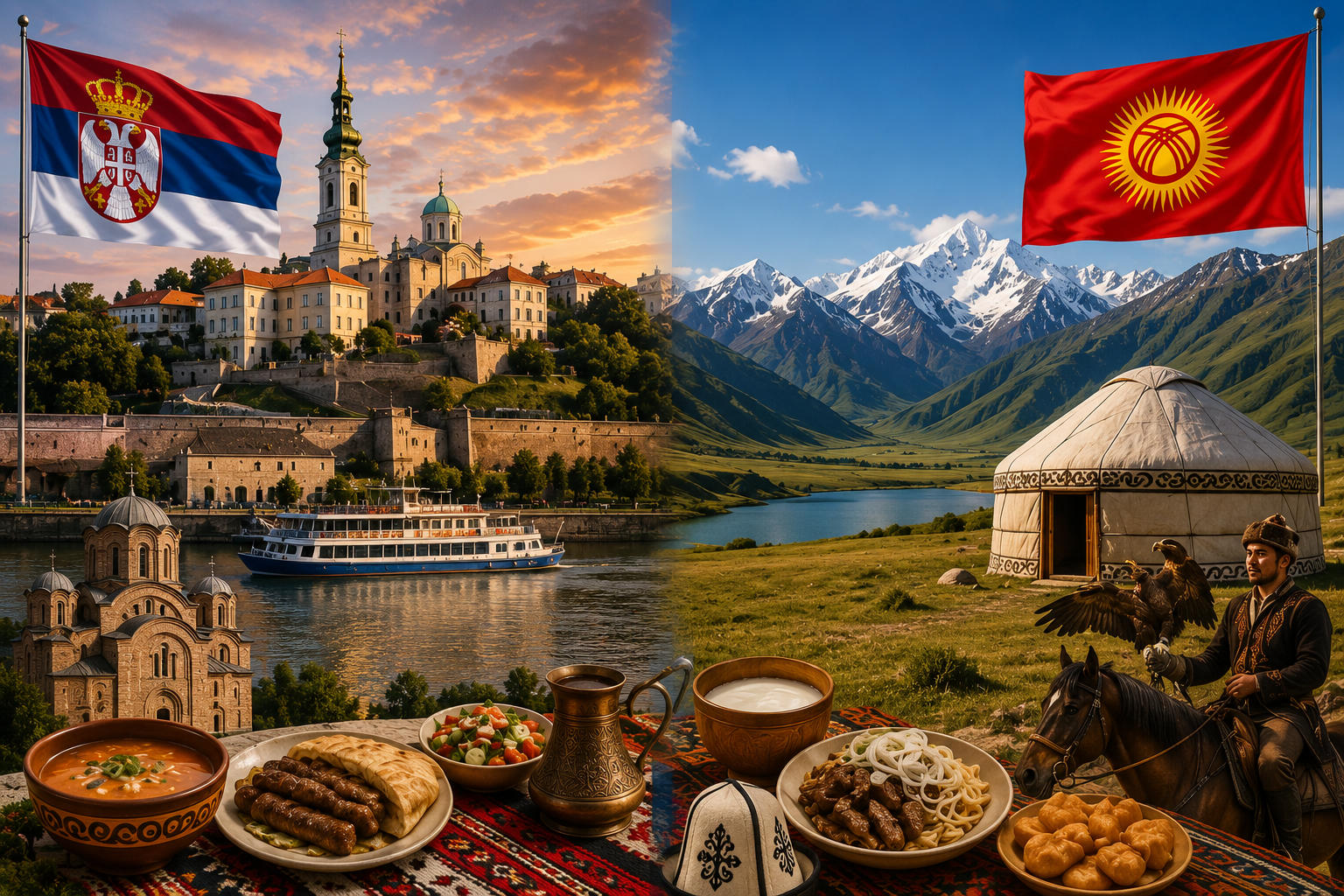
Serbia and Kyrgyzstan are two relatively small countries located in different parts of Eurasia, but there are a number of interesting similarities between them from a geographical, political and geostrategic point of view. That is why they are often seen as middle powers on the periphery of large geopolitical centers that strive for a multi-vector foreign policy, which makes them suitable for comparative geopolitical analysis.
Characteristic similarities
Geographical similarities make comparisons between them particularly interesting. The populations of the two countries are similar, Serbia has about 6.6 million people, and Kyrgyzstan – about 7.3 million. Both countries are landlocked, located at the crossroads of large geopolitical spaces, depend heavily on international transport corridors and use their geographical location as an economic advantage.
Serbia and Kyrgyzstan were formed as independent republics in the same cycle of the centrifugal trend in international relations at the end of the 20th century – the collapse of the multinational states of Yugoslavia and the USSR respectively. Although they belong to different regions, Serbia and Kyrgyzstan have a similar model of foreign policy behavior. Both use their geographical location to conduct a multi-vector foreign policy, avoiding complete binding to a single center of power. They strive to maintain good relations with several major powers at the same time: Serbia – with the EU, the USA, Russia, China, Turkey. Kyrgyzstan – with Russia, China, Turkey, the countries of Central Asia, gradually expanding its contacts with the EU and the USA.
China is a key economic partner for both countries, while Russia remains an important factor in the security sphere. The main difference is that Serbia has a clearly expressed European integration perspective, while Kyrgyzstan is permanently integrated into Eurasian political and economic structures.
There is another interesting point of intersection: Serbia and Kyrgyzstan are among the few countries in Eurasia that are both actively participating in China’s Belt and Road Initiative and seeking to extract maximum economic benefits without giving up their multi-vector foreign policy. The role of China as a strategic partner for both Kyrgyzstan and Serbia is a particularly pronounced similarity. Serbia is one of China’s most important partners in Europe. Beijing is investing in infrastructure, mining, metallurgy, telecommunications. The main emphasis in Kyrgyzstan is on roads, tunnels, power grids, loans, and the China-Kyrgyzstan-Uzbekistan railway project. In both cases, China uses infrastructure investments as a tool to strengthen its influence.
Authoritative rulers
Although the political systems of the two countries are outwardly different – Serbia is a parliamentary republic and Kyrgyzstan is a presidential republic – there are interesting political parallels between them: dominant ruling parties, relatively weak and fragmented opposition, use of infrastructure projects as a tool for political legitimacy, striving for strategic autonomy by balancing between competing great powers.
From an analytical point of view, the most important similarity is the authoritarian style of governance of the long-standing strongmen in both countries – President Aleksandar Vučić in Serbia and President Sadyr Japarov in Kyrgyzstan. Although Serbia is a parliamentary republic, Vučić achieved a strong concentration of personal power in two consecutive presidential terms, thanks to the dominant role of the ruling party – the Serbian Progressive Party.
The strengthening of the presidential vertical of power in Kyrgyzstan is happening in a specific way. The President of Kyrgyzstan, Sadyr Japarov, after replacing the parliamentary system with a strong presidential model, continued the transformation of the political architecture in the country. For five years, Japarov ruled in tandem with his loyal political associate, the chairman of the State Committee for National Security, Colonel-General Kamchibek Tashiev. However, on March 10, 2026, K. Tashiev was removed from office and later sentenced to four years in prison, with probation, on charges of attempting to seize power. According to some regional observers, not only the lack of evidence is the reason for the lenient sentences against Tashiev and his group, but also Bishkek’s desire to avoid confrontation with London, which has used this group to advance its interests. In any case, the main goal of the trial against Tashiev and his group is to stop their path to the elections. Having eliminated his main competitor, his long-time ally and security chief Kamchibek Tashiev, Japarov announced presidential elections for January 27, 2027, in which he hopes to win another term.
The dismantling of the Japarov-Tashiev tandem and the destruction of the latter’s power pyramid lead to further short-term consolidation and centralization of President Japarov’s power. The dominance of pro-presidential forces over the legislative branch, limited political competition, and personalization of power allow for quick decision-making with minimal institutional resistance.
President Japarov has established personal control over the special services, but their influence in society, the economy, and diplomacy will not be limited. The new head of the State Committee for National Security, Maksat Asanaliev, has been tasked with purging the agency of supporters of its former head, Kamchibek Tashiev, on the eve of the 2027 elections.
In Serbia, power is no less concentrated in the hands of President Vučić, who personally controls the ruling party, without being formally its chairman, state structures, the security sector, and the media.
There will probably be presidential elections in Serbia in January, but incumbent President Vučić is not eligible to run for a third term. He is expected to call early parliamentary elections beforehand, which, if won, would allow him to take over the prime minister post, which constitutionally grants him full power. However, Vučić must be wary of his power due to the ongoing protests in the country, which have escalated into demands for a change in the governance model. A recent poll by the New Serbian Political Thought shows that the Student List, which emerged on the crest of the protest wave, is supported by 39.6% of respondents, while the list of the ruling Serbian Progressive Party is supported by 37.5%.
Multi-vector foreign policy
The foreign policy of both Serbia and Kyrgyzstan is highly pragmatic, with a strong desire for diplomatic activity. In 2026, Kyrgyzstan achieved its greatest foreign policy success – its election as a non-permanent member of the UN Security Council, and on September 1, the country will host the annual summit of the SCO.
Serbian diplomacy has also entered a “new era” of balanced foreign policy and strategic cooperation with Israel and the United States. Serbian Foreign Minister Marko Đurić, summarizing diplomatic activity over the past 60 days, said that official Belgrade has significantly strengthened its positions on the international stage thanks to intensive contacts with key world players. A strategic dialogue was launched with the United States, which is a turning point in relations between the two countries. As a result of Belgrade’s constant reminders of the situation of Serbs in Kosovo, Washington suspended the strategic dialogue with the authorities in Pristina. Đurić visited several Asian, Eurasian and Western countries.
External Implications
The rapid realignment and personalization of Kyrgyzstan’s political system favors closer economic and political rapprochement with Moscow and Bishkek’s functioning as a reliable partner in circumventing sanctions. Moscow’s role in Kyrgyzstan’s security and labor migration architecture will remain. The government has strengthened macroeconomic stability by transforming the country into a logistics and offshore hub for Russia. So far, Bishkek has managed to adapt to the sanctions, but its growing dependence on Moscow increases the threat of secondary sanctions.
The Kremlin has tacitly approved of President Sadyr Japarov’s actions and advised Tashiev’s supporters not to provoke a confrontation. Russia is providing Kyrgyzstan with the resources it needs to maintain stability in the country and to counter the forces inside and outside the country that are causing problems.
Chinese companies dominate the import flows that feed Russia-oriented supply chains. This dynamic allows Kyrgyzstan to balance its two largest neighbors, drawing benefits from both while mitigating the risks of overdependence on one. Bishkek will not reorient its policy toward Washington, but will seek diversification and avoidance of confrontation – it will welcome American capital and diplomatic visibility, but is unlikely to threaten existing security relations (with Moscow) or economic relations (with Beijing).
Serbia’s geopolitical trajectory is developing in a different direction – away from Moscow and closer to Washington. Belgrade’s too close cooperation with Moscow and Beijing could not help but attract the attention of the United States, which is shifting from Sarajevo and Podgorica to Belgrade and Skopje. The United States supports EU efforts to develop Serbia’s lithium deposits and sets a condition for removing Russian ownership and corporate governance of the state-owned company NIS, in order to stop the flow of financial resources to Russia. Washington seeks to divert all key infrastructures of Russia and China, which influence political decisions in Belgrade.
The forced contraction of economic and especially military ties of Moscow with Serbia – the friendliest country of Russia in Europe, forces the Kremlin to change the Russian state strategy, focused on elites and key players, and to direct it to the priority development of the subnational level of cooperation in all areas, creating and maintaining horizontal ties between individual regions, regardless of the political situation. To maintain its interests and influence in Serbia, Moscow applies cheap or asymmetric means to slow down the country’s integration into Western institutions. “People’s diplomacy” as a means of Russian soft power, however, cannot compensate for the previous economic, political and military influence of Russia on Serbia.
Calm before the storm
A deceptive calm before the storm reigns in Kyrgyzstan as well. Tashiev’s supporters, southern elites, disgruntled officials and part of the old opposition have not yet formed a united front. The situation remains calm and the confrontation between the elites and their supporters remains in the form of controlled pressure and negotiations. The country is undergoing a process of property redistribution, now under the control of the president. But Kamchibek Tashiev is not one to simply give up power. Deeply offended, he has stated that “the calm is deceptive”, meaning that he may create problems for Japarov in the midst of the election campaign, by supporting his political rivals or using the “ethnic code”. Tashiev considers Japarov to be his younger brother who has shown ingratitude and treachery. Driven by hatred and a thirst for revenge, rather than a desire for power, he will try to organize a coup against the president, probably after the SCO summit.
In the long term, the new political model in Kyrgyzstan disrupts the balance between regional elites and undermines systemic stability. Responsibility for the state of the country is now personalized and addressed directly to the head of state. The imbalance caused by the weakening of the southern clans, whose representative is Tashiev, carries the risk of rekindling traditional tensions on a geographical and clan basis. The elimination of informal balancing mechanisms is a prerequisite for destabilization in the medium term, which, combined with a possible economic downturn, could disrupt joint infrastructure projects, including the China-Kyrgyzstan-Uzbekistan railway.
Energy implications
In both Serbia and Kyrgyzstan, strong energy dependence on Russia is at the root of the energy crises that both countries are experiencing.
The US push to oust Russian ownership of Serbia’s largest oil company, NIS, has caused a critical fuel situation in Serbia.
Kyrgyzstan imports about 90-95% of its fuel from Russia, but it has almost stopped exporting due to its own crisis following Ukrainian drone strikes on energy facilities. Kyrgyzstan’s domestic fuel reserves are only enough for 4 to 6 weeks. In the short term, alternatives to supplies from Russia are extremely limited, and any other option would require significant investment in infrastructure. This vulnerability also becomes a matter of high living costs and social stability.
Authoritarianism is not going away
Kyrgyzstan, considered the most liberal and democratic country in Central Asia, is embarking on the trajectory of authoritarianism inherent in its neighbors. In about six months, on January 27, 2027, if another Kyrgyz revolution does not happen by then, Japarov will know whether he remains in power.
Serbia, located in the center of Europe, has a longer tradition of authoritarianism – the eras of Josip Broz Tito and Slobodan Milosevic, which Vučić clearly wants to emulate. In six months, he will also know more about his fate.
Although the question of power in Serbia and Kyrgyzstan is yet to be resolved through elections, the people of both countries have shown in the past that they are able to solve their problems by means of street pressure – the overthrow of Milosevic in Serbia in 2000 and the two revolutions in Kyrgyzstan in the past two decades.