Thewesternbalkans.
The “Flamingo Revolution” in Albania—which began on May 31 in opposition to a luxury tourist complex project in a protected ecological zone in Zvërnec, and subsequently evolved into anti-government protests—has escalated over the past two weeks.
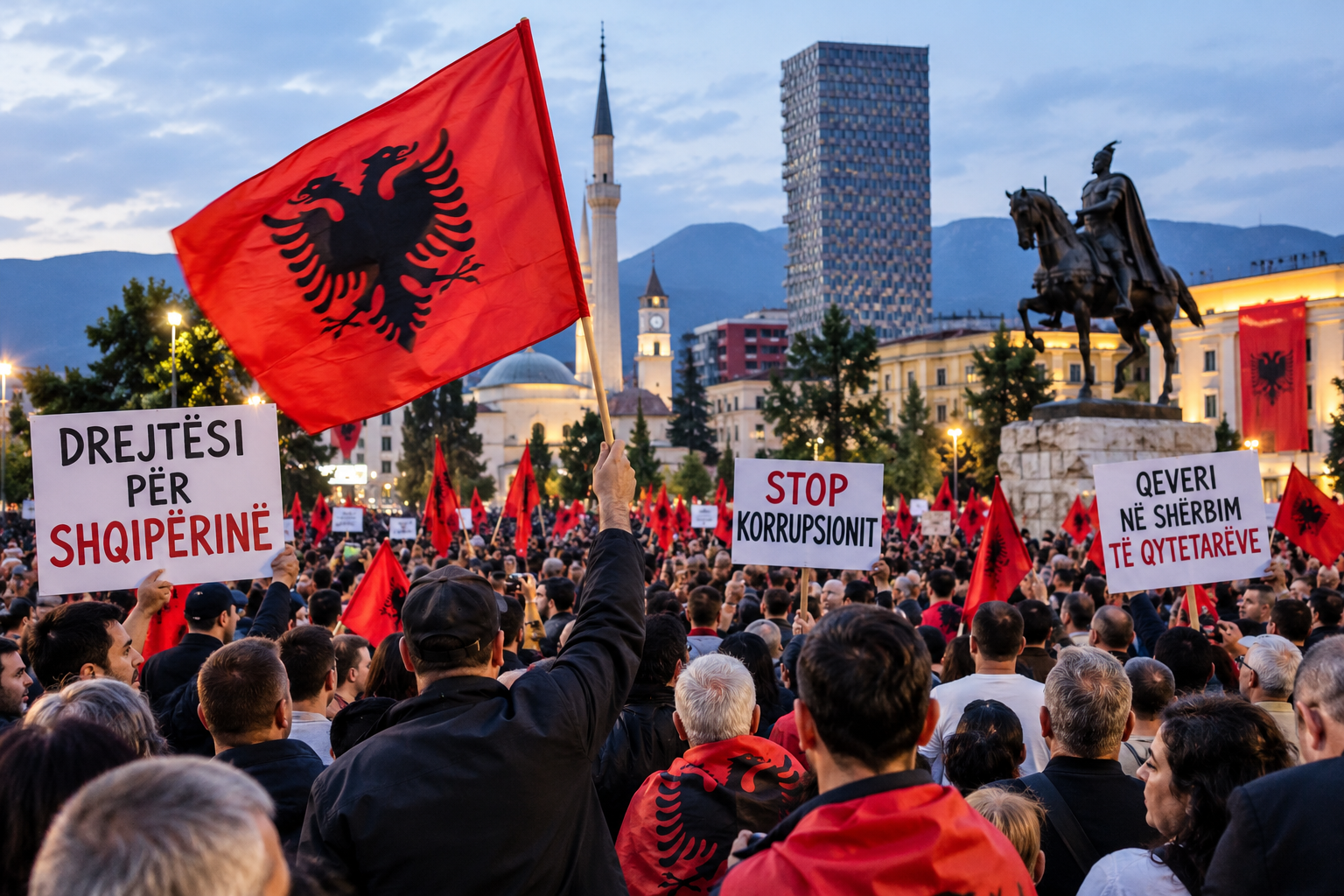
Thousands of people have taken to the streets of Tirana, demanding the Prime Minister’s resignation, citing the high cost of education and corruption. The protests quickly escalated into acts of destruction and violent clashes with the police.
The anti-government protests in Albania have turned into a protracted political crisis. Since October 13, every day has been marked by demonstrations in Tirana and elsewhere. Students, schoolchildren, faculty members, and ordinary citizens are calling daily for the resignation of Prime Minister Edi Rama. Marches toward the Council of Ministers and the Parliament have ended in evening clashes with the police, involving the throwing of stones and incendiary devices, met by the police with the use of water cannons and tear gas. The deployment of specialized police units and repeated dispersal operations have failed to resolve the confrontation. Attacks on state institutions, allegations of serious police misconduct, and increasingly hardline government rhetoric point to further escalation.
The union of university staff has announced an indefinite boycott of classes at public universities, effective October 21, in support of the students. The organization called for an independent investigation into police violence. The boycott has been applied unevenly: classes are continuing at a number of regional universities.
Immediate Consequences
During the unrest in Albania, government buildings—including the Supreme Court and the entrance to the National Bank of Albania—were set on fire; vehicles were damaged, and a bridge was also damaged. Protesters attempted to storm the government complex and the residence of Prime Minister Edi Rama, throwing paving stones, fireworks, and Molotov cocktails at security forces.
More than 1,000 protesters were arrested. Criminal proceedings have been initiated against 388 individuals. Complaints have been raised regarding violence and a lack of adequate safeguards during detention, prompting calls for official reviews. The Ombudsman found overcrowding and substandard detention conditions for protesters in Tirana.
In Tirana, police used rubber bullets against demonstrators. Seven police officers have been suspended for abuse of power. Meanwhile, the Council of Ministers increased the number of police officers eligible for additional compensation for securing the protests from 2,750 to 2,821.
The District Court in Tirana ordered the release of 22 detained protesters, placing them under a “mandatory appearance” requirement; the court ruled that the arrests of 17 of these individuals were unlawful. As of October 21, the Ministry of Health reported a total of 320 casualties since the protests began on October 13—comprising 192 police officers, 92 demonstrators, and 36 bystanders, including six journalists. Nine individuals remain under medical care at the University Trauma Hospital in Tirana.
Minister of Economy Delina Ibrahimaj announced that 90 business entities have reported damages resulting from the protests. Ten teams from the tax administration are currently assessing the extent of the damage to determine potential compensation.
Governor of the Bank of Albania Gent Sejko gave assurances that the banking system remains stable, despite attacks that occurred during the protests. According to the Albanian Association of Banks, 45 branches—24 of which sustained serious damage—and 53 ATMs were affected; however, approximately 85% of branches in Tirana remain operational. The payment system is functioning normally.
Events in Parliament
On October 22, the unrest that had persisted for several days spilled over into the Albanian Parliament, with the session concluding in a mass brawl among members of parliament. A verbal confrontation between representatives of the ruling party and the opposition Democratic Party—which supports the street protests—rapidly escalated into a full-scale physical altercation.
Such incidents are not uncommon in the Albanian Parliament; disputes and quarrels frequently erupt, and lawmakers have been known to readily hurl whatever objects are at hand at one another. On this occasion, however, the escalation reached a new peak. Lawmakers from the Democratic Party blocked the rostrum, overturned chairs, and damaged microphones and voting devices, demanding a debate regarding the protests and police actions. The parliamentary group of the ruling Socialist Party has called for disciplinary measures against opposition MPs in connection with the incidents, including a 60-day suspension for seven of them. The Democratic Party has characterized these demands as political pressure. The divide within parliament merely reflects the level of tension currently unfolding on the streets of Albanian cities.
The Spiral of Political Crisis
The opposition Democratic Party continues to support the protests, demanding the resignation of the government and the dissolution of parliament. Blendi Klosi, General Secretary of the ruling Socialist Party, stated that Edi Rama’s resignation is not up for negotiation and that political changes should be brought about through elections.
The two parties exchanged accusations regarding involvement in the violent incidents, with each side rejecting the claims made against it.
Democratic Party leader Sali Berisha dismissed allegations that the opposition was orchestrating violent acts and called on his party’s structures to support the protesters. He insisted on Edi Rama’s resignation and announced that political and legal assistance would be provided to demonstrators who had been detained.
The government has been compelled to make certain concessions to the protesters; it is preparing a scheme to cover 50% of the rent for students in Tirana who meet specific criteria. A draft law on affordable housing also includes provisions for interest-free loans for young families, as well as loans with a 3% interest rate for certain categories of young professionals. However, these proposals have not yet been implemented as actual measures.
What did Albanian Prime Minister Edi Rama do?
“Albania has become a target of a well-coordinated attack,” the Prime Minister declared. Rama pointed out that among the protesters were “young men and women who have been radicalized by dark forces in Europe and the USA.” At the same time, he also accused Russia and Iran of destabilizing the country. Meanwhile, Rama refuses to resign and appears determined to quell the protests completely. At one point, reports circulated on social media claiming that the Prime Minister had left the country. In reality, Prime Minister Edi Rama traveled to Budva, Montenegro, for the Berlin Process summit held on October 21–22. During the trip, he publicly addressed questions from a protesting student regarding police conduct, university issues, and corruption, affirming his willingness to engage in dialogue.
The issue of dialogue is noteworthy, as Edi Rama—in an attempt to reconcile with the protesters—issued public invitations for talks with the students. Some of the protesters continue to reject any meeting until accountability is established for the actions of the police. At the same time, according to the BBC, Rama told police chiefs: “The moment the state begins negotiations with them, the state will fall.”
Prime Minister Edi Rama announced the preparation of measures targeting individuals involved in violence during the protests: a special registry, identification via technology, potential restrictions on travel and access to services, and financial liability for damages caused by minors. However, it was his plan to impose collective financial liability for the acts of destruction that sparked the greatest stir. Rama announced that not only those directly involved in the riots, but also all demonstrators who happened to be nearby in the crowd and failed to distance themselves from the radicals in time, will be held liable for broken glass, arson, and the restoration of buildings in Tirana.
Albanian media reported that Edi Rama has instructed his ministers to arrange for the resignation of the heads of the state institutions under their authority. It is likely that, through these personnel changes, Rama is attempting to maneuver in order to remain in power.
International Reactions
Bulgarian Member of the European Parliament Andrey Kovatchev, the EPP rapporteur for Albania, urged that the demands of the young protesters be taken seriously and that violence from all sides be investigated. The European People’s Party also condemned attacks on institutions and called for peaceful demonstrations and proportionate police action.
UN High Commissioner for Human Rights Volker Türk called for dialogue and the protection of the right to peaceful assembly in Albania. He condemned attacks on property and requested an independent investigation into reports of the use of disproportionate police force, including against minors.
Claude Haagen, the OSCE Parliamentary Assembly’s Special Representative for South-East Europe, urged the authorities, the opposition, and the protesters to exercise restraint, engage in peaceful dialogue, and uphold the right to assembly.
Reporters Without Borders reported 28 instances of violence, threats, and obstruction directed at journalists between October 13 and 19. At least 23 media workers were affected; according to the organization, most of these incidents were linked to police actions. It has called for an independent investigation and parliamentary oversight.
The International Press Institute reported that at least 38 journalists and other media workers were attacked, injured, or obstructed while covering the protests in Albania. The organization has demanded guarantees for the safety of the media and their ability to work freely.
The American Chamber of Commerce in Albania has expressed concern regarding damage to businesses and disruptions to economic activity resulting from the protests. The organization called for better protection of private property and highlighted issues—such as corruption, unfair competition, bureaucracy, and the informal economy—that were identified in its business environment index.
The Final Battle Approaches
Edi Rama refuses to acknowledge his own government’s failures, accusing the protesters of being “funded from abroad” and of bringing individuals with criminal records onto the streets. He has refused to resign, claiming that the violence was perpetrated by a few hundred masked men.
However, the situation in Tirana has spiraled completely out of control. Mass student protests, which have been ongoing for two weeks, have escalated into clashes, and as of October 20, the parliamentary opposition has openly joined the movement. In a show of solidarity with the students, the Democratic Party organized its own march. Tensions in Tirana remain high, and the victory achieved by students in Belgrade could prove to be a powerful catalyst for the Albanian protesters as well.