
Siana Gyorcheva
On January 7, 2026, in Skopje, the Prime Minister of the Republic of North Macedonia, Hristian Mickoski, stated that the inclusion of Bulgarians in the constitution was not Sofia’s only demand and that Bulgaria aimed to “completely redefine the Macedonian identity.” His words were spoken after the solemn liturgy for the Nativity of Christ in the Skopje Cathedral, in response to a journalistic question, and not as part of an official press conference.
Mickoski accused the previous government of accepting an “ultimatum” from its eastern neighbor and thus blocking the country’s European integration. He called for national unity against external pressure and said that Skopje was reaching out, but Bulgaria must give up its positions.
In the Balkan context, such statements are never just diplomatic remarks. They are an attempt to turn a European and legal requirement into an emotional issue of identity. Thus, an international commitment is replaced by an internal political narrative.
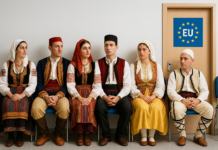
Bulgaria does not go beyond the framework of European standards. The constitutional recognition of the Bulgarian community is part of the agreed negotiating framework, which all other candidate countries have fulfilled. Presenting this condition as an attack on the Macedonian nation is a form of political manipulation.
The reality of the Bulgarian presence in North Macedonia cannot be erased with declarations. Tens of thousands of citizens of the country hold Bulgarian passports, issued after presenting official documents of origin. These are archives and genealogies, not memories of family conversations. If Bulgarian identity were a fiction, such a phenomenon would not exist.
The documents from before 1945 are even more eloquent. Ottoman registers, exarchical books, reports by Western diplomats and early censuses show widespread Bulgarian self-determination in the region. The post-war Yugoslav project builds a new national model, but it cannot erase the older reality that still emerges today under the official narrative.
From a geopolitical perspective, Bulgaria defends the logic of the European Union itself. The EU is built on predictability and respect for signed agreements. If Skopje can unilaterally revise the accepted conditions, the entire enlargement process will be meaningless. Therefore, the Bulgarian position coincides with the European one, regardless of the way it presents itself inside North Macedonia.
The future of North Macedonia in the EU will not be decided by the power of patriotic speeches, but by the readiness of the state to accept the simple rule that international treaties stand above the current political situation. If the current line is maintained, the country risks remaining an eternal candidate without a real perspective.
From the Bulgarian point of view, the issue is extremely clear. Europe cannot be built on the denial of people and documents. If Skopje continues to treat its citizens with Bulgarian identity as a problem, it will isolate itself from the European family not because of Sofia, but because of its refusal to accept European principles.
Sooner or later, any government in Skopje will have to fulfill what was agreed. The EU will not compromise on constitutional guarantees, and time is running out against the current rhetoric. The younger generations, the economic ties to the European market and the fact that thousands of citizens already have a direct connection to Bulgaria through documents and citizenship will make this turn inevitable.
The Bulgarian position is not just national, it is European. She defends the idea that the Balkans should live by rules, not myths. If North Macedonia wants a future in the EU, it will have to accept that identity is not defended by denying the other, but by respecting truth and rights.
Understanding this reality is the only bridge that can lead North Macedonia from the politics of confrontation to genuine European integration.
Author’s bio: Siana Gyorcheva is a historian in Sofia, graduated in History with a specialization in Geopolitics of the Balkans. Her scientific interests are related to geopolitical processes in the region, the situation of the Bulgarian national minority in the Balkan countries, and relations between Bulgaria and the Republic of North Macedonia. Her thesis is dedicated to the politics of Serbia and Greece in the historical and geographical region of Macedonia and the contemporary dimensions of the Macedonian question.