
Thewesternbalkans.
Albanians and Serbs have historically had old scores to settle in the Balkans. Even today, Kosovo is a source of tension between them. But the paradox is that today, the protests in both Albania and Serbia have identical goals – the overthrow of their own hated governments.
The month-long protest movement in Albania, called the Flamingo Revolution, was sparked by plans by Jared Kushner, President Trump’s son-in-law, to build a tourist complex in a protected ecological zone on the Adriatic coast, inhabited by rare species such as the pink flamingo.
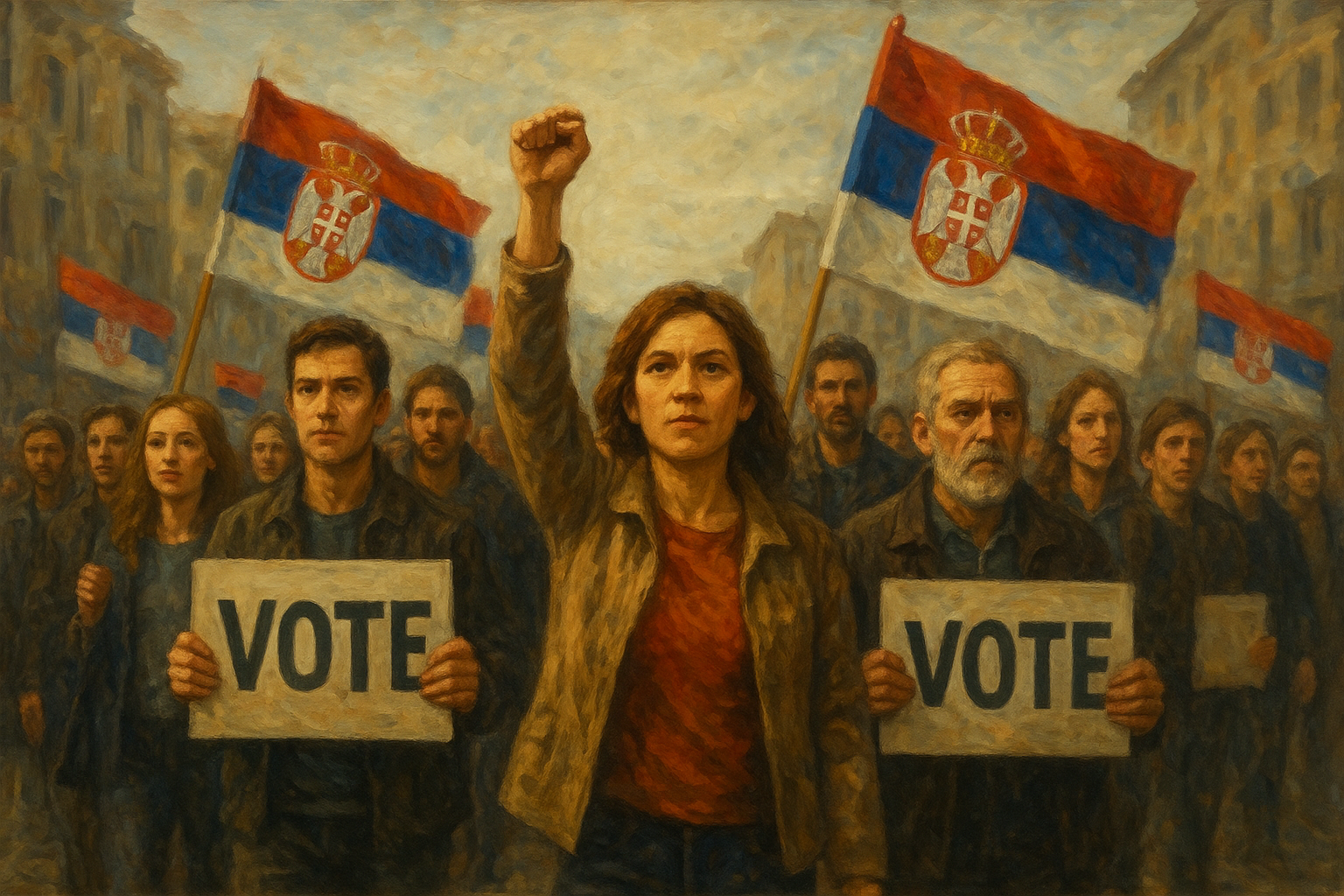
The second-year protest movement in Serbia was initially not directed against the regime, but aimed at making institutions do their job in connection with the deadly incident at the Novi Sad train station on November 1, 2024. But the institutions protected by the regime refused to do anything, and then the students – the driving force of the protests – decided to seek a way out in changing the system, although this was not their initial scenario.
Reasons for the protests in Albania
Albania is the most pro-American country in the Western Balkans, and one should not expect an American investment to provoke such strong resistance. But the investment project itself is not the only reason for the protests.
The roots of the protest are much deeper, and a major factor in the current Albanian protest wave is that the government no longer represents the interests of the population. From its very beginning, the protest has been directed against the country’s opaque governance and corrupt oligarchic elite. Edi Rama, who has been in power for 13 years, is intoxicated by a sense of his own infallibility and greatness, makes decisions without communication and consultation with the population and does not fulfill the promises made to the population for democratic development. The protests are directly related to the rule of law in the country, which should be the basis of Albania’s Euro-Atlantic integration.
Economic reasons are also a factor in the protests. Rama focuses the development model only on sectors such as tourism or construction, which benefit the elites and clientelistic networks. This only leads to a violation of the social pact between the rulers and the ruled. An important factor in the protests are the young people, who are now seeking social realization in their own country, and not in emigration.
Geopolitical dimensions of the protests in Albania
The protests do not question the geopolitical framework of Albania’s development. Both the elite and the population are overwhelmingly pro-EU, pro-NATO, pro-US. However, the protests also have a geopolitical dimension. For financial or geopolitical reasons, Prime Minister Edi Rama is ready to sell part of the Albanian Adriatic coast, driven by a sense of impunity, typical of other authoritarian Balkan leaders. The geopolitical dimension of the protests in Albania is indirect, insofar as the project will be implemented by companies associated with Kushner and the Trump family, who present their business interests as US interests.
But the main geopolitical dimension of the protests in Albania lies in the signal they are sending: external powers should apply in Albania and in the Balkan region the same democratic principles that they are promoting in the integration process. The protesters are demanding the same thing that the EU, and before that the US, wanted – rule of law, transparency, accountability of the government, and the fight against corruption.
Therefore, the protests will not change Albania’s geopolitical orientation. The protesters are demanding the acceleration of the implementation of democratic standards, the implementation of adopted laws, and the acceleration of EU membership. In their reports on Albania’s progress in the integration process, both the Commission and the EU Parliament rather timidly and diplomatically point out the difference between the laws, policies, and strategies of candidate Albania, on the one hand, and their implementation, on the other. However, through the protests, the population is quite categorically expressing what the EU also wants – the elimination of corruption, rule of law, transparency and representativeness of government, and democracy. The delay in reforms threatens the accession to the EU, to which Tirana has officially committed itself. Rama, who is not interested in reforms, is bringing the country closer to the United States and developing ties with other external powers, such as Turkey.
Albania’s political and economic evolution will be indicative of the credibility of the EU’s broader geopolitical project. External powers are more focused on stability in the Western Balkans region than on democratic processes, transparent governance, and functioning institutions. As long as the broader regional framework remains stable and the current political leadership remains in power, major short-term disruptions are unlikely, but a decisive breakthrough in Albania’s EU accession process also seems unlikely. According to a number of experts, Albania’s declared commitment to EU membership and Brussels’ rhetoric of merit-based enlargement are accompanied by discouraging messages from the EU to the Western Balkans. For example, they spent years discussing the abolition of roaming fees, which were abolished for Ukraine from January 1, 2026. Austrian diplomat Klaus Wölfer rightly notes that such double standards encourage Balkan states to diversify their strategic relations and place greater emphasis on ties with the United States, as well as with powers such as Turkey, China, and Russia. Such dynamics are visible not only in Albania, but above all in Serbia.
Comparison between the protests in Albania and Serbia
There is no mutual inspiration or coordination between the two protest movements – in Albania and Serbia. But the accumulated and smoldering dissatisfaction with irresponsible governance and corruption is so strong that any spark can ignite a rebellion, and the example is contagious.
The protests cause great discomfort to the rulers, and especially to the autocrats Vučić and Rama, who are forced to use cunning, narcissism and vulgarity to seek ways to survive, because they feel that the beginning of the end of their long-standing rule has come. Both Vučić and Rama came to power at the same time and use the same textbook for governance – that of dictatorship. The way Rama and Vučić govern is very similar, although with different geopolitical orientations.
Despite A. Vučić’s monthly statements about early elections, he has no serious intentions to step down from power before the EXPO 2027 in Serbia starting in May next year, which will be his personal show.
Rama also stated that he will not hand over power before the country enters the EU (i.e. not before the end of the decade). He is a rather authoritarian politician at home, but this helps him to appear strong on the outside and demonstrate a clear pro-European position. Rama is arrogant at home and cooperative on the outside. Rama’s efforts to label the protests in Albania as pro-Greek, pro-Serbian, pro-Iranian or anti-Semitic have not affected their scale. Nor will Belgrade’s divergent speculations that the protests are inspired by the West or Russia stop the wave of protests in Serbia.
Similarities:
The protests in Serbia and Albania have more similarities than differences. They have a common basis – dissatisfaction with corruption and the way of governance – but differ in their origin, organization and immediate demands.
Particularly important in the context of European integration is that in both countries, which are candidates for EU membership, the protesters show why they aspire to the EU: they raise demands for the rule of law, judicial independence, transparency and accountability of government, democracy. However, the signals from the EC to the protesters are either missing or not so clear, although at the peak of the protest wave in Serbia the number of protesters as a percentage of the country’s population is comparable to the magnitude of the protests that overthrew the communist system in Eastern Europe.
In both countries, the protesters accuse the ruling class of corruption, clientelism and weakening of institutions. The targets are corrupt governments. In both countries, the protests are gradually growing from a specific cause to broader demands for political change.
The youth are the driving force behind the protests in both Serbia and Albania. They have no prominent leaders, no structural political leadership, but they include people of all ages and from different political or ideological backgrounds. The movements are heterogeneous and will have difficulty transforming into a political project.
Kouchner is partly a common denominator for the protests in Albania and Serbia, insofar as he decided to build a hotel on the site of the General Staff of the Serbian Army in the center of Belgrade, which was destroyed by NATO in 1999. The structural commonality is that in both Albania and Serbia these are areas protected by the state – in the first case an ecological reserve, in the second case a national historical monument.
Differences:
The most important difference is the nature of the movement: in Serbia, the protests are largely a civic and student movement, seeking to be non-partisan and to demand institutional accountability. In Albania, the protests are more closely intertwined with party politics, with a more visible role for opposition political forces, although civic and environmental groups also make important contributions. The environmental element is central to the current wave of protests in Albania. Protesters claim that protected natural areas are being sacrificed for the benefit of large investors.
In both countries, the protests reflect accumulated dissatisfaction with corruption and governance, but in Serbia the emphasis is on institutional accountability after a specific tragedy, while in Albania the protests combine anti-corruption, political and environmental demands.
In Serbia, the movement is largely student-led and seeks to maintain distance from political parties, although it is developing towards institutionalization.
Albania’s environmental degradation has been going on for years, but it has never received the kind of media attention that the “flamingo revolution” did. The current protests in Albania cannot yet be called a real revolution, but Prime Minister Edi Rama is forced to fight for his survival.
Although the EU and the US have common interests in preserving stability in the Western Balkans, Brussels fears that the US may make deals with some countries in the region that do not follow EU rules. In such a case, a conflict of interests may arise and the EU must react. The leaders of countries like Albania must decide what is more important – their profits and the interests of the Trump family or joining the EU, which is the will of the population.
Despite the huge internal dynamics, in Albania for now everything remains as it was, which is typical of other countries in the Western Balkans. The protests may subside, as happened in Serbia, but the signal is important – the youth of the Balkans are for justice and against double standards.