Thewesternbalkans.
Serbia’s European Ambitions Through the Lens of President Vučić
During the European Union–Western Balkans Summit held in Tivat, Montenegro, Serbian President Aleksandar Vučić held a dedicated press conference outlining Serbia’s positions on the summit and its broader approach to the European integration process.
An analysis of President Vučić’s remarks provides valuable insight into Belgrade’s current strategic thinking regarding both the EU enlargement agenda and Serbia’s place within it.
Economic Strength as a Foundation of Policy
A central element of Serbia’s narrative is the belief that the country has become the strongest economy in the Western Balkans, both in absolute terms and relative to its size. Serbian officials increasingly present economic performance as the principal source of national confidence and regional influence.
This economic dimension was emphasized by President Vučić, who stated:
“For me, the most important thing is always how we will attract investments and how I will fight for the interests of the citizens of Serbia, so that people in Serbia can see that we are working in their interest and that they can live better.”
This approach reflects Belgrade’s conviction that economic growth and foreign investment remain the primary benchmarks against which both domestic and foreign policy should be assessed.
International Engagement and Serbia’s Strategic Relevance
Another key message from Tivat was Serbia’s effort to demonstrate its value as a reliable and indispensable regional partner.
President Vučić highlighted a series of meetings with leading European figures, including French President Emmanuel Macron, German Chancellor Friedrich Merz, European Commission President Ursula von der Leyen, and European Council President António Costa. According to Vučić, the discussions focused on Serbia’s European future, the enlargement process, and the implementation of reforms under Serbia’s EU agenda.
He also underlined the importance of his meetings with regional leaders and several EU member-state representatives, including Bulgarian President Rumen Radev, Czech Prime Minister Andrej Babiš, Slovak Prime Minister Robert Fico, Albanian Prime Minister Edi Rama, and Croatian Prime Minister Andrej Plenković.
The message conveyed by the Serbian President was clear: despite occasional political disagreements, Serbia remains an indispensable interlocutor both within the Western Balkans and in its relations with major European actors.
Kosovo and Regional Stability
Commenting on Montenegro’s recognition of Kosovo, Vučić reiterated Serbia’s longstanding position. While acknowledging that Montenegro’s decision had been difficult for Serbia to accept, he stressed that Belgrade respects the sovereignty of its neighbours and has no intention of interfering in Montenegro’s internal affairs.
This statement was consistent with Serbia’s broader diplomatic effort to project an image of regional responsibility and political maturity while maintaining its position on Kosovo.
Enlargement Process and Mutual Respect
Asked about his expectations from the summit, President Vučić described it as one of the most important gatherings involving the EU and the Western Balkans in recent years.
He expressed optimism regarding the future of enlargement while acknowledging that Serbia still has substantial work to do in implementing reforms. Significantly, he emphasized what he viewed as a change in tone from European leaders.
According to Vučić, the discussions were conducted on the basis of mutual respect rather than political lecturing, an aspect that Belgrade appears to value highly.
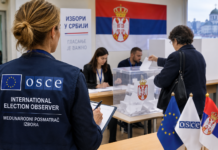
During his meetings with senior EU officials, Vučić presented Serbia’s ongoing reform efforts, including measures related to the rule of law, electoral legislation, and the implementation of recommendations from European institutions. He reaffirmed Serbia’s commitment to implementing all recommendations of the Venice Commission in accordance with European standards.
The Serbian President also highlighted the importance of peace, stability, and regional cooperation as prerequisites for further progress. At the same time, he called for a credible enlargement policy and a clearer European perspective for the countries of the Western Balkans. In this context, he expressed hope that the EU would further refine its enlargement methodology in order to facilitate the accession process for candidate countries.
Between East and West
One of the most revealing moments of the press conference came when Vučić was asked whether Serbia felt closer to the European Union than to Russia.
His response reflected the essence of Serbia’s current foreign policy doctrine: “We are on our path toward the EU. That is all I can say. That is our strategic goal. But I lead a sovereign, independent and freedom-loving nation.”
The emphasis on sovereignty and independence has become a recurring theme in Serbian foreign policy discourse. While Belgrade continues to define EU membership as a strategic objective, it remains equally committed to preserving decision-making autonomy and maintaining relations with a broad range of international partners.
Assessment
Two key characteristics emerged from President Vučić’s appearance in Tivat: considerable self-confidence and a strong emphasis on national sovereignty.
His repeated references to Serbia as a “sovereign, independent and freedom-loving nation” are not merely rhetorical. They reflect the political philosophy underpinning Belgrade’s contemporary foreign policy. Combined with Serbia’s position as the largest economy in the Western Balkans, this approach suggests that the country will continue pursuing a multi-vector foreign policy, seeking to balance its relations with the European Union, the United States, China, Russia and other international actors.
At the same time, Serbia remains committed to the EU accession process. The challenge for both Belgrade and Brussels will be to find a political and legal framework that accommodates Serbia’s desire for strategic autonomy while satisfying the European Union’s requirements for membership.
The Tivat Summit demonstrated that Serbia continues to view its European future as compatible with an independent foreign policy. Whether this balance can be sustained over the long term remains one of the central questions of the Western Balkans’ political development.