
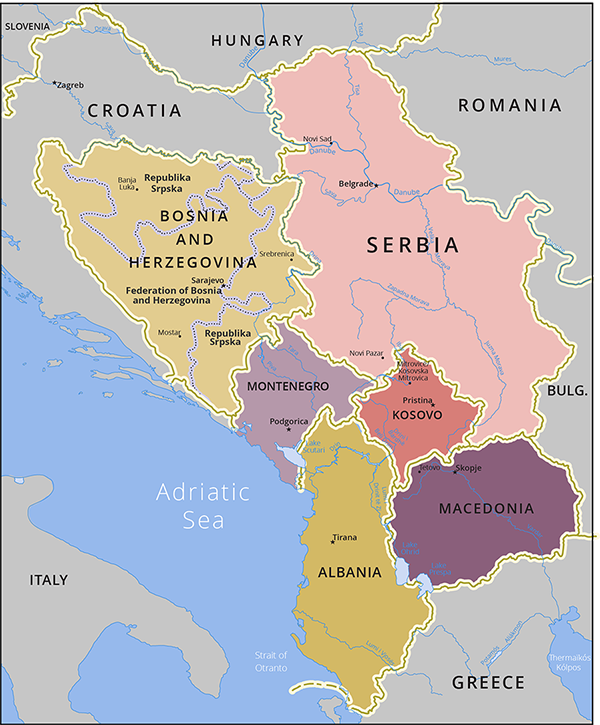
Thewesternbalkans.
Although geographically distant from the Middle East, the Western Balkan countries are not isolated from the consequences of the military conflict between the United States, Israel and Iran. Due to their economic dependence, political vulnerability and strategic location, the region experiences indirect but tangible impacts in terms of security, economy, energy and foreign policy.
The Western Balkans, which are still recovering from their own conflicts in the 1990s, remain sensitive to all forms of destabilization. Radicalization processes may intensify, especially through online propaganda and ideological influence. In addition, security services in the countries of the region are forced to increase surveillance and coordination with NATO and European Union allies to prevent potential threats.
The Western Balkans are highly dependent on imported energy resources, which makes them vulnerable to rising oil and natural gas prices. This in turn leads to inflationary pressures, increased production costs and a decrease in the purchasing power of the population. Small and medium-sized economies in the region find it difficult to compensate for such external shocks, which can lead to social tension.
The war in the Middle East is forcing the countries of the Western Balkans to seek alternative sources and routes for energy. This is accelerating the processes of diversification, including investments in renewable energy sources and strengthening regional cooperation. At the same time, however, the short-term effects are rather negative, as the infrastructure and capacity for rapid adaptation are limited.
The conflict between the United States, Israel and Iran puts the countries of the Western Balkans in a delicate position. Most of them are oriented towards Euro-Atlantic integration and maintain close relations with the United States and the European Union. This implies political support for Western positions, but at the same time creates the risk of worsening relations with other international partners, including countries that have a different position on the conflict. Balancing these interests requires careful diplomacy and strategic planning.
The reactions of the Western Balkan countries to the conflict between the US, Israel and Iran are shaped mainly by their foreign policy orientation, the degree of Euro-Atlantic integration and domestic political balances. Due to the strong geopolitical fragmentation of the Western Balkan region, the conflict in the Middle East has intensified existing political and strategic divisions. In general, the Western Balkan countries can be divided into two main groups:
– The pro-Atlantic oriented (Albania, Kosovo, Montenegro, North Macedonia), which support the US and its allies;
– The balancing or internally divided (Serbia and Bosnia and Herzegovina), which take a more cautious or ambiguous position.
Serbia
Serbia has traditionally followed a policy of military neutrality and balancing between the West, Russia and other global actors. In the context of the conflict, it has taken a more moderate and cautious position. Belgrade has avoided outright support for military action against Iran and has emphasized the need for a diplomatic solution. This position is dictated both by the desire to maintain good relations with various partners and by domestic political considerations. Official Belgrade expresses support for the Gulf countries, primarily the UAE and Qatar, which are significant business partners of Serbia and allies of the United States. At the same time, Serbia is increasing military-technical cooperation with Israel, but also with China.
Montenegro
As a member of NATO, Montenegro demonstrates a clear Euro-Atlantic orientation. The country usually supports the positions of the United States and its allies, including with regard to security in the Middle East. Its reaction is characterized by political support for allied actions, although without direct military participation. Podgorica places emphasis on collective security and stability.
North Macedonia
North Macedonia, also a member of NATO, follows a similar line to that of Montenegro. The government expresses support for allied positions and emphasizes the importance of international law and security. At the same time, the country has sought to avoid internal tensions by maintaining a moderate tone in public rhetoric.
Bosnia and Herzegovina
Bosnia and Herzegovina’s response is more complex due to its internal political structure. Different ethno-political groups often have divergent foreign policy preferences. This makes it difficult to formulate a unified position. In general, the official line remains cautious and focused on calls for de-escalation, but internal divisions are also reflected in foreign policy signals.
Kosovo
Kosovo is among the most categorical supporters of the United States in the region. As a country whose independence is closely linked to American support, Pristina clearly sides with Washington and its allies. The support is mainly political and diplomatic, emphasizing the importance of the strategic partnership with the United States.
Albania
Albania, also a NATO member, has demonstrated strong support for the United States and its Western allies. Tirana has traditionally pursued a pro-American foreign policy and has been threatened by Tehran with retaliation for sheltering Iranian opposition figures.
The war in the Middle East has become a strong additional motive for the further militarization of the Balkans. Latent tensions in the region have intensified and dividing lines in the Balkans have deepened. The military and political confrontation between Serbia and Croatia has reached a critical level, with even diplomatic channels of communication being cut off. Zagreb perceives the purchase of new modern weapons from Serbia as a direct threat, and Belgrade feels threatened by the triple military alliance of Croatia-Albania-Kosovo. This raises the question of whether and how NATO will support its member Croatia in its rivalry for regional leadership with neighboring Serbia? Some observers fear that sparks from the war in the Middle East could reignite the Balkan powder keg.