
Thewesternbalkans.
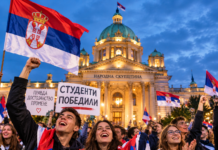
According to some Serbian media and analytical websites, Ana Brnabić, Speaker of the National Assembly of Serbia, claimed that the EU enlargement “is not a process based on merits, but on political will”.
In her speech at the annual summit “EU-Western Balkans”, organised in the beginning of December by the “Friends of Europe” in Brussels, Brnabić stressed that she was “a little bit confused about the EU accession process”. “Is it based on meritocracy or is it purely political will? You know, it is absolutely not a merit-based process. The phrase that it is merit-based has almost become an insult to most of us in the Western Balkans because it has nothing to do with setting goals. And when you achieve the goals in terms of implementing reforms, the clusters will not magically open”, she noted.
Commenting on Brnabić’s claims, Pierre Mirel, a former Director of the Directorate-General for Enlargement at the European Commission stressed that “Mrs. Speaker Brnabić should not be confused because it is both a merit-based and a political process”.
“The answer for Mrs. Speaker is in the so-called “new approach”, which was set in 2011 by the European Commission… It implies that the overall accession process, i.e. the opening of the negotiating chapters (clusters), cannot move forward unless you move on in Chapters 23 and 24 – the “fundamentals”. So, Mrs. Speaker has the answer, she should not be confused”, Mirel remarked.
Elaborating on the political dimension of the EU enlargement process, Mirel said that the candidate countries, which today completely align with the Common Foreign and Security Policy of the EU, “should participate in the Foreign Affairs Council, without voting right”.
According to him, it “would be a very important gesture by the EU, also for the population of these countries”.
Comments: It is completely understandable for Ana Brnabić to make such a statement. She is defending her country’s position from the level of the Speaker of the National Assembly. At the same time, however, it is clear to everyone with at least some knowledge of the process that Serbia will not advance sufficiently in the EU integration process until it fully adopts the EU’s foreign policy and security policy. The current international situation is such that the senses of officials in Brussels are highly alert, and they cannot tolerate neutral countries that wish to join the EU.
In this sense, Pierre Mirel’s comment is absolutely accurate. However, it is difficult to accept the thesis of the participation of candidate countries that adhere to the EU’s Common Foreign and Security Policy in the EU Foreign Affairs Council even without voting rights. This would mean that the Republic of North Macedonia would receive its seat in the Foreign Affairs Council, despite the openly anti-European rhetoric of the country’s ruling authorities.