Thewesternbalkans.
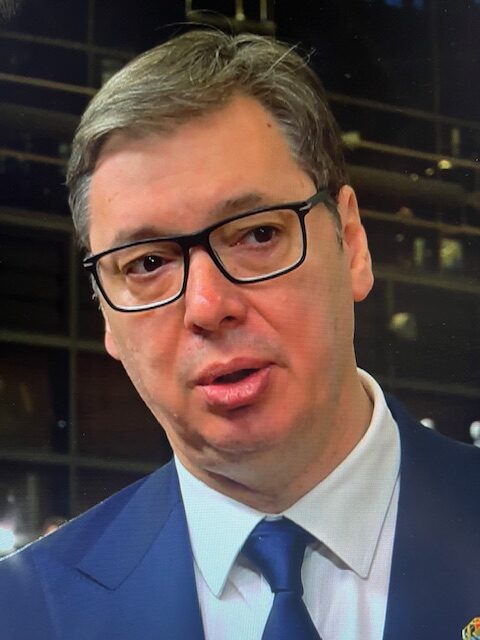
According to Serbian and international media, on September 27, President Alexandar Vučić officially announced his resignation addressing the public. He handed Ana Brnabić, in his office, the presidential seal, decrees on state decorations, pardon documents covering both of his terms in office, the register of gifts, a financial report, a report on the work carried out, and a report on ongoing court disputes and enforcement proceedings.
The official handover record states: “This record documents the transfer of duties between Aleksandar Vučić, President of the Republic, who is resigning, and Ana Brnabić, President of the National Assembly, who is assuming the office of Acting President.”
Vučić also wished Serbia’s new acting president a happy birthday, joking that she was taking over her new position on her birthday.
Brnabić said she was honored to have assumed the office from Aleksandar Vučić, stressing that Serbia would never again have a president who was so devoted to fighting for the protection and preservation of Serbia.
She added that, from today, Vučić was embarking on a determined new struggle to protect and preserve Serbia, and wished him success in that effort.
Under the Constitution, Brnabić can remain acting president for a maximum of 90 days.
It should also be recalled that Vučić said in his address to the public from the Palace of Serbia on the night of September 27, when announcing his resignation as president, that the presidential election would most likely be held in December.
Comments: Aleksandar Vučić’s resignation from the presidency and the holding of snap parliamentary elections in Serbia are part of a well-known tactic to defuse social tension. Formally, Vučić has met the demands of the months-long protests. However, as a result of the current parliamentary and presidential campaign, Vučić can expect to become the country’s prime minister following the formation of a governing coalition. Constitutionally, Serbia is a parliamentary-presidential republic where all power is concentrated in the hands of the government. Regardless of how events unfold, the new Serbian president—whether from the ruling party or the opposition—will find themselves in the long shadow of Prime Minister Vučić’s political apparatus.