Thewesternbalkans.
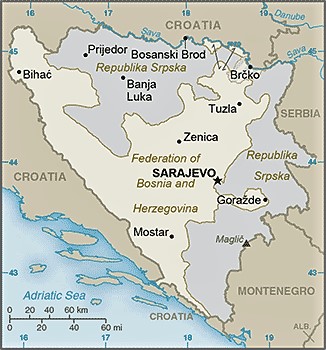
The general elections in Bosnia and Herzegovina held on October 4, 2026, yielded several particularly significant results: the end of the “Komšić model” regarding Croat representation; an improvement in the position of Croats in BiH; the survival of Milorad Dodik’s political system despite his removal from institutional power; and the return of the three traditional ethno-political parties as the primary pillars of the Bosnian political system.
1. Croat parties have further consolidated their political power in areas where Croats constitute a majority or have a strong presence; however, they have lost some of their bargaining leverage in areas where Croats are a minority. For the first time in four terms, Željko Komšić has failed to secure the seat of the Croat member of the tripartite Presidency of BiH.
Darijana Filipović, the candidate for the HDZ BiH, won the Croat seat because Bosniaks did not participate en masse in the election of the Croat member of the Presidency this time around. This means that the Croat community will once again be represented in the Presidency by a candidate from the main Croat party, rather than by Komšić—who, in his previous terms, was elected with the decisive support of Bosniak voters. Croats view him as a “pseudo-Croat” and an “anti-Croat”—an illegitimate representative, or effectively a second Bosniak member of the Presidency. The victory of the HDZ BiH for the Croat seat in the Presidency means that Zagreb gains a more predictable partner in Sarajevo regarding the “Croat question.” HDZ BiH leader Dragan Čović has signaled that he will seek an agreement with the SDA on joint governance.
2.The balance of power within the predominantly Bosniak electorate is shifting. The SDA has once again become the strongest party in the Federation of BiH, while the civic (multi-ethnic) parties—which draw their support primarily from the Bosniak electorate—have emerged from these elections weakened. The SDA secured more votes than its leader, Bakir Izetbegović, did as a presidential candidate. This is because he has remained in politics for too long without offering any new ideas. Furthermore, he failed to leverage the advantages of being in the opposition. The dismantling of the “Komšić model” represents a significant setback for Bakir Izetbegović.
3.In Republika Srpska, the SNSD has maintained its dominance and consolidated its position. An interesting paradox has emerged: while Dodik has formally lost his power as President of Republika Srpska, his political system remains intact. His ally, Savo Minić, has won the presidency, and the SNSD retains its leading position in the National Assembly of Republika Srpska. Additionally, Željka Cvijanović has won the Serb seat in the state-level Presidency.
In reality, Dodik is the biggest winner of these elections. A change in the individual holding the office does not signify a change in political direction. Although not formally president, he holds the same role and utilizes all available resources to maintain total control.
Dodik’s victory was not achieved without support from the U.S. administration. Two of Donald Trump’s advisors—James Blair and Chris LaCivita—deemed it necessary to visit Banja Luka in the midst of the U.S. midterm election campaign to provide electoral support to Dodik (for a fee of hundreds of thousands of dollars each). This likely occurred without the President’s authorization, and he has since distanced himself from them. Strong support from the U.S. administration for Dodik runs counter to American interests regarding the supply of LNG via a pipeline running through Croatia and Bosnia and Herzegovina. For its part, Republika Srpska has paid $35,000 per month this year to the American consulting and lobbying firm Continental Strategy to facilitate contacts with White House officials. The daughter of Susie Wiles, the President’s Chief of Staff, works at this same firm.
4.Another shift—less conspicuous at first glance, yet more profound—is that the elections have reinforced ethnic-based politics. There is a clear return to the three primary ethno-political centers: the SDA (representing Bosniaks), the HDZ BiH (representing Croats), and the SNSD (representing Serbs). The end of the era of the “second Bosniak” and the Croats’ acquisition of a genuine political voice objectively work to the advantage of the Serbs in their struggle against the Bosniaks’ vision of a unitary Bosnia.
5.The biggest loser in the elections in BiH is the EU—the topic of European integration was absent from the election campaign, and the elections do not remove the deadlock hindering European integration. For the EU, the new Presidency might appear more predictable in terms of ethnic representation; however, the outcome does not automatically create a greater capacity to implement the reforms necessary for the accession process. Rather than a classic competition between “pro-European” and “Eurosceptic” parties, BiH continues to function as a set of three ethno-political systems that must reach an agreement. Dodik is likely to obstruct reforms, leaving the EU dissatisfied with the progress.
Consequently, the EU finds itself without leverage in BiH. Significant external leverage lies in the hands of the United States and, to a lesser extent, Russia (via EUFOR, the OHR, Brčko, and the Republika Srpska), as well as—to some degree—Serbia, Croatia, and Israel. Full details regarding US economic projects in BiH and Israel’s specific commitments remain unavailable.
What comes next?
In the near term, one should not expect Republika Srpska to declare independence outright. Over the coming year, we are likely to see moves toward a “soft” institutional separation—a gradual, de facto decoupling of institutions, occurring without a formal legal separation. During this period of frozen confrontation, Dodik will receive support from Aleksandar Vučić, as this strengthens Serbian influence in BiH and upholds the argument that the interests of Bosnian Serbs must be defended. However, Vučić will not support an overt, formal secession, which would trigger a direct Western response. If he retains political control following the elections in Serbia, he will likely attempt to act as an intermediary between the West and Republika Srpska.