Thewesternbalkans.
Different media report that High Representative in Bosnia and Herzegovina Christian Schmidt has resigned from the post after nearly five years at the Office.
The German diplomat has already informed the Steering Board of the Peace Implementation Council (PIC) of his intention and requested the launch of the procedure for selecting a new High Representative.
Schmidt will continue to perform all regular duties in fully capacity until the appointment process for his successor is completed.
Schmidt’s resign was preceded by demands from RS that he be expelled from BiH, as the authorities in the entity consider his appointment illegitimated. In recent days, messages from Republika Srpska calling for Schmidt to step down as a High Representative had intensified.
During his mandate, Schmidt repeatedly warned about secessionist policies, institutional blockades and attempts to undermine Bosnia and Herzegovina, stressing that the international community remains on the side of the country’s citizens.
The planned departure of Bosnia’s international High Representative, Christian Schmidt, has exposed growing tensions between Europe and the United States over the future of Bosnia and Herzegovina, while reviving fears of renewed instability in the Balkans nearly three decades after the Dayton Peace Agreement ended the Bosnian war.
In a interview with Germany’s Frankfurter Allgemeine Sonntag Zeitung, Schmidt denied that Washington had forced him out of office, but acknowledged “intensive discussions” surrounding his resignation after five years as the international community’s top overseer in Bosnia.
“I am not a victim. I am a free man,” Schmidt said when asked whether American pressure had contributed to his departure.
His comments come amid increasing speculation in diplomatic circles that the United States under President Donald Trump is reassessing its Balkan strategy and regional energy projects tied to American business interests.
Schmidt suggested that Bosnia remains vulnerable to separatism, foreign influence and institutional paralysis.
Much of the interview focused on growing concerns over Republika Srpska Former President Milorad Dodik, who has repeatedly threatened secession and deepened ties with Russia, Hungary and figures close to Trump’s MAGA movement in the United States.
Schmidt referred to reports of lobbying contracts in Washington allegedly linked to efforts to remove him from office and secure support for Republika Srpska’s independence.
The interview also highlighted disputes surrounding a proposed gas pipeline project intended to reduce Bosnia’s dependence on Russian gas supplies routed through Serbia. Schmidt criticized Europe for lacking a coherent regional strategy and warned that Bosnia remained almost entirely dependent on Russian energy.
“Europe should not only react, but act,” he said.
The project has become controversial after reports that companies linked to associates of former Trump adviser Michael Flynn were expected to receive special voting rights connected to the pipeline development.
Schmidt stopped short of directly accusing Washington of supporting Dodik’s separatist ambitions, but warned that redrawing borders in the Balkans would create new instability.
The interview reflects wider anxiety in Europe over the future of Bosnia as geopolitical competition intensifies between the West and Russia and as nationalist movements gain momentum across the region.
European officials fear that weakening international oversight in Bosnia could embolden separatist forces and reignite ethnic tensions, particularly at a time when the European Union itself appears divided over enlargement and security policy.
Schmidt also warned about growing Islamophobia and inflammatory rhetoric directed at Bosniak Muslims in Bosnia’s political discourse, saying ethnic hatred had become increasingly normalized.
Despite decades of international involvement, Bosnia remains politically fragmented and economically weak, with reforms stalled and ethnic divisions deeply entrenched. Critics increasingly question whether the international governance model established after Dayton has succeeded in building a functional state.
His departure now raises new uncertainty about who will replace him — and whether the next phase of Bosnia’s postwar history will be shaped more by Brussels, Washington or increasingly assertive regional nationalist actors.
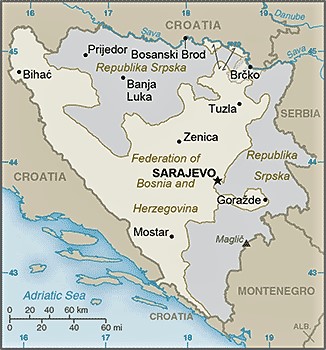
Comments: Schmidt, a senior German conservative politician from the Christian Social Union (CSU), has served as High Representative since 2021. The office was created under the 1995 Dayton Peace Agreement, which ended Bosnia’s war but established one of the world’s most complex political systems, dividing the country into two highly autonomous entities — the Bosniak-Croat Federation and the Republika Srpska.
The High Representative possesses sweeping executive powers, including the authority to impose laws and dismiss elected officials, powers known as the “Bonn Powers.” Critics have long argued that the office undermines Bosnia’s sovereignty, while supporters insist it remains essential for preserving the fragile state.