Thewesternbalkans.
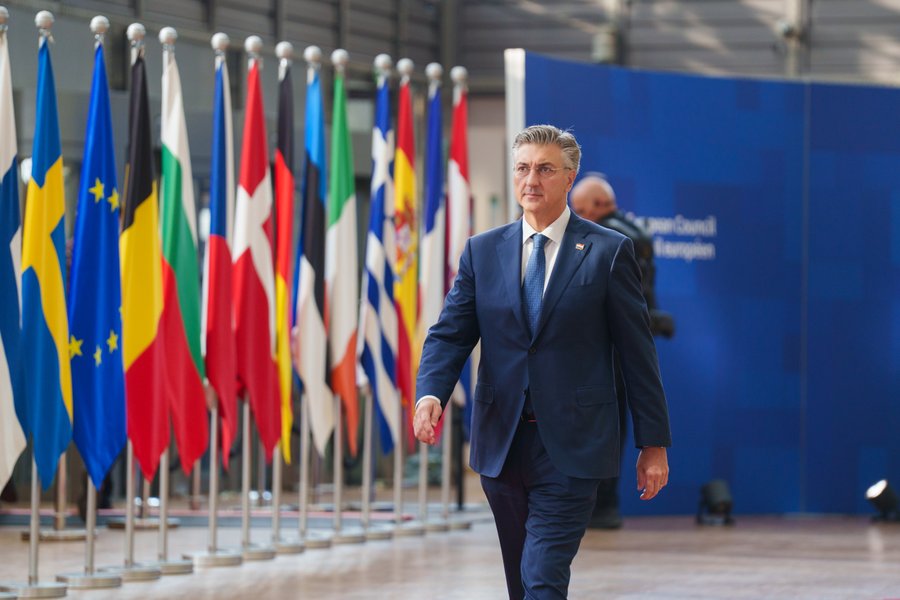
October 19, 2026, marks exactly ten years since Andrej Plenković assumed the office of Prime Minister of Croatia. He has led three consecutive governments, formed following the parliamentary elections of 2016, 2020, and 2024. With the conclusion of Viktor Orbán’s 16-year tenure in Hungary in 2026, the leader of the ruling Croatian Democratic Union (HDZ) has become the longest-serving incumbent prime minister among EU member states.
Where did Andrej Plenković’s career begin?
From 1994 to 2002, Plenković—a law graduate—held various positions within the Croatian Ministry of Foreign Affairs. In 2002, he became the Deputy Head of Croatia’s Mission to the EU. He also served as Deputy Ambassador to France and as State Secretary for European Integration. He has been a member of the HDZ since 2013, and by 2016, he had become the party’s chairman.
Before assuming the premiership in 2016, Plenković served as a Member of the European Parliament for three years. At the time he took office, Croatia had already been an EU member for four years.
What has kept Andrej Plenković in office for so long?
Croatia’s last decade can be viewed through two parallel trends: on one hand, deeper European integration, economic growth, and the strengthening of the country’s international standing; and on the other, persistent issues regarding corruption, housing affordability, demographic trends, and the quality of public governance.
Undoubtedly, a key factor is the political longevity of Andrej Plenković is his contribution to the country’s strong economic performance in recent years.
And these results are truly impressive: the Croatian economy has shown sustained growth. According to the European Commission, real GDP grew by 3.4% in 2025—marking the fifth consecutive year that growth has exceeded the EU average. Economic growth for 2026 is projected at around 2.3%. For the first time, GDP will surpass 100 billion euros. The public debt-to-GDP ratio is declining. By July, the average net wage had reached 1,540 euros, while the average pension stood at 780 euros.
In his annual report to Parliament on October 13, 2026—marking the third year of the HDZ’s third consecutive term—Prime Minister Andrej Plenković stated: “Ten years of continuity have enabled us to ensure political stability and a clear path for Croatia’s development, even under the most challenging circumstances… Croatia has made progress, the economy has strengthened, and the standard of living for our fellow citizens has risen.”
Despite stable macroeconomic indicators, ordinary citizens on the streets of Zagreb are far from satisfied. The demographic crisis is deepening—3.5 million Croatians live abroad, while the domestic population stands at 3.8 million and continues to decline. People complain about everyday issues, such as those in the healthcare sector and waste collection. “I’ve worked for 40 years and am about to retire, yet my pension has been set at 380 euros,” lamented a 64-year old woman, cashier in Zagreb.
Rising incomes do not automatically solve the problem of purchasing power. In 2025, inflation in Croatia reached 4.4%, and the European Commission forecasts a rate of 4.6% for 2026. This places pressure on households—particularly pensioners, young families, and those with lower incomes.
“Every country has a mafia, but in Croatia, the mafia has a country,” a taxi driver in Zagreb remarked grimly—a sentiment, incidentally, echoed by citizens in other Balkan countries regarding their own nations.
Indeed, Plenković’s government has been plagued by numerous corruption scandals. Yet, there have been tangible results in the fight against corruption: between 2016 and 2023, approximately 30 ministers implicated in scandals were removed from the government.
The ruling coalition in Croatia does not fear a vote of no confidence in parliament, and for the time being, there is no prospect of early elections. Opposition parties are currently engaged in processes of consolidation and repositioning, and they have no interest in new elections.
HDZ’s coalition partners have shown no signs of leaving the coalition. In parliament, the ruling bloc—comprising the HDZ, the right-wing “Homeland Movement” (DP), smaller parties, and independent MPs, alongside the 8 seats reserved for national minorities—holds a majority of three seats; furthermore, they also receive support from MPs outside the governing coalition.
“We face three priority tasks: strengthening the economy amidst uncertain circumstances, building a more resilient society with stronger institutions, and bolstering Croatia’s sovereignty and security,” Plenković stated in parliament. Among his other key priorities are demographic revitalization, improved access to housing for the citizens, better healthcare, energy security, a more efficient judicial system, and the modernization of the Croatian Armed Forces.
Strong International Standing
The most visible achievements relate to European integration. On January 1, 2023, Croatia adopted the euro and joined the Schengen Area. Croatia has also strengthened its standing within European diplomacy.
Plenković’s foreign policy stance is characterized as pro-European and moderate—an exception against the backdrop of a broader trend of Euroscepticism across Europe. The Croatian Prime Minister states that the country is leveraging its strengthened international standing “to continue implementing a policy of modern sovereignty, to defend national interests and our core values, as well as to bolster security and unlock development opportunities.” This enhanced international position enabled Zagreb to amend the European Council Conclusions (October 15–16, 2026) to send a clear message to Podgorica: Montenegro must enter into negotiations with Croatia to resolve outstanding issues before it can be admitted to the EU. In certain other European capitals, there was relief that Zagreb was prepared to shoulder the blame for any potential delay in Montenegro’s accession.
Overcoming fatigue?
Certainly, the positive outcomes from a decade of governance under the HDZ administration will not lead to complacency when party leader Andrej Plenković addresses the party elite at the HDZ assembly, scheduled to take place in Šibenik on November 28. The wear and tear resulting from the HDZ’s long-standing governance, combined with voter fatigue, are compelling the party to offer something different from its current platform if it wishes to retain power following the next regular parliamentary elections, which must take place no later than April 2028.
Andrej Plenković’s political resilience and the Croatian Democratic Union’s three consecutive electoral victories demonstrate an ability to maintain power and ensure policy continuity. However, an assessment of the past decade depends not only on the institutional integration achieved and economic growth recorded, but also on the extent to which these outcomes have had a lasting impact on quality of life, equal access to opportunities, and public trust in institutions.
A defeat for the HDZ in the upcoming elections would come as a surprise, given that Plenković benefits from the organizational advantage of a large, well-established party. The most likely scenario is that the HDZ will remain the leading party but lose its majority. As of early October 2026, polls still place the HDZ ahead of the opposition SDP; however, should the DP continue to weaken, Plenković will be forced to seek new partners. Croatian voters are unlikely to support the incumbent government if it offers them nothing more than “more of the same.”