Thewesternbalkans.
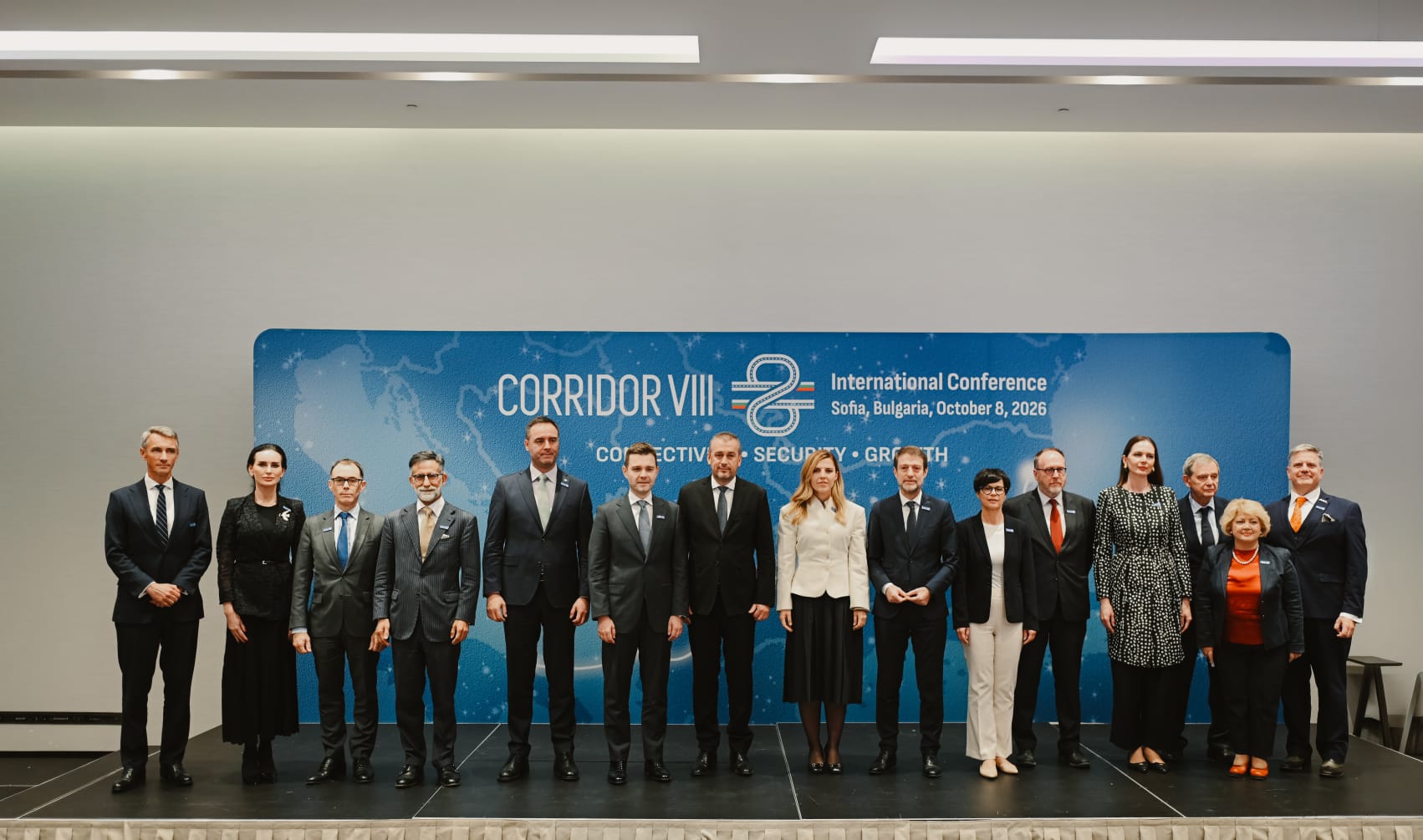
An international ministerial conference on Pan-European Corridor VIII was held in Sofia on October 6 – 2026, focused on Connectivity and European Security.
The forum brought together ministers and senior officials from Bulgaria, Albania, Italy and the Republic of North Macedonia, as well as representatives of Romania, Kosovo and Montenegro. Participants also included EU Enlargement Commissioner Marta Kos, senior officials from the European External Action Service and NATO, and representatives of the US, UK and Ukraine.
The programme included three discussion panels:
- the geopolitical context of Corridor VIII;
- transport, energy and economic connectivity;
- military mobility and security, including hybrid threats, innovation and new technologies.
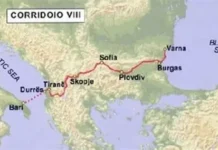
Corridor VIII connects the Adriatic and Black seas through Albania, North Macedonia and Bulgaria, incorporating road and railway infrastructure. One of its main unfinished sections is the railway connection between Bulgaria and North Macedonia.
Speaking to journalists on the arrival, Marta Kos said participants had gathered to work towards better transport links for future generations.
Kos described Bulgaria as a gateway to Europe for the region of Black sea. She also spoke of the role of the Western Balkans in regional connectivity, with more than 130 projects under way.
She shared her vision for EU enlargement included the eventual integration of the entire Western Balkans into the Union. This would require joint efforts by EU institutions, Member States and Western Balkan countries, as border crossings and transport links would likely take on a different role in a more closely integrated Europe. According to Kos, North Macedonia and Albania were seeking EUR 319 million in EU funding for Corridor VIII and thanked Bulgaria for its leading role in developing transport and energy links. The connectivity summit in 2027 would be an important step in improving Europe’s transport links, she said.
Marta Kos also said Europe stood in solidarity with Bulgaria following drone attacks on ships in Bulgarian waters. She described the attacks as blatant violations of international law and a reminder of the security threats facing Europe.
Speaking to journalists before the conference, Bulgarian Foreign Minister Velislava Petrova said the meeting offered an opportunity to assess progress on the corridor’s various sections. She described Corridor VIII as a strategic project for Bulgaria that should be treated as a single project rather than a series of separate ones. Work was under way to meet the project’s deadlines by 2032, she said.
Petrova added that Bulgaria would host a connectivity summit in 2027 focused on the Middle Corridor, which would link the country with the rest of Europe and the Western Balkans. The 2027 regional connectivity summit, to be co-hosted by Bulgaria and the European Commission, would focus on diversifying routes, tripling trade flows and reducing transit times for goods by 2030. Bulgaria would also explore ways to link the Middle Corridor to existing connectivity networks.
Taking part in the panel on military mobility, security, hybrid threats, innovation and new technologies, Deputy Defence Minister Lyubomir Monov said that military mobility is a key factor in Europe’s security. He highlighted the role of Corridor VIII as a strategic link across the Balkans connecting the Adriatic and Black seas and creating a continuous logistics corridor along NATO’s southern and eastern flanks. Its importance in ensuring an effective response to crises extends beyond the region and is directly linked to the security of the entire Euro-Atlantic area. Providing appropriate transport infrastructure and establishing procedures for the unhindered movement of armed forces and military equipment across Europe enables NATO to implement its collective defence plans and helps strengthen the Alliance’s deterrence capabilities. Corridor VIII is a key element contributing to the development of NATO-EU cooperation, Monov also said.
North Macedonia’s Minister of Foreign Affairs and Foreign Trade Timco Mucunski said Corridor VIII was much more than a transport link, as it strengthened relations between the Western Balkans and the European Union. The project is a clear national strategic priority for North Macedonia and described the agreement with Bulgaria on the construction and operation of the cross-border railway tunnel as a success. He added that the corridor could become a platform for energy connectivity, digital infrastructure, trade, investment, logistics and security. Mucunski also said North Macedonia would host the next ministerial meeting on Corridor VIII in Skopje.
Albanian Minister for Europe and Foreign Affairs Ferit Hoxha described Corridor VIII as an economic, security and European necessity. Geography became a strategic asset only when countries succeeded in building connections with one another.
Hoxha outlined the project’s economic, European and security dimensions. He said the corridor would lower costs, speed up transit, attract investment and create jobs. European integration became tangible to citizens when journeys were shorter, borders easier to cross and businesses able to reach European markets in hours rather than days, he added. Energy, transport and digital links determined countries’ resilience and independence. “Infrastructure is also geopolitics,” Hoxha said.
Hoxha said Corridor VIII would be completed only if all countries fulfilled their commitments. Albania expected the same determination from its European partners, he added.
Comments: Infrastructure is also geopolitics. Pan-European Corridor VIII is a key transport route connecting the Adriatic Sea ports of Bari and Brindisi in Italy with the Black Sea ports of Varna and Burgas in Bulgaria. It spans approximately 960 kilometres of roadway and 1,270 kilometres of railway, facilitating east-west connectivity across the Balkans. The corridor was established to enhance freight and passenger movement while promoting economic integration in the region. Despite securing substantial EU funding, implementation has faced challenges, with only partial segments operational as of 2025. Recent advancements include Bulgaria’s electrification projects and North Macedonia’s cross-border tunnel plans, which aim to complete core links by 2029.
Photo: mfa.bg