Thewesternbalkans.
The modernisation of the Alexandroupolis-Odessa transport corridor is a Greek initiative and supported by the European Commission. It is part of the Greece-Bulgaria-Romania trilateral framework, which also includes Moldova and Ukraine. Connecting the Aegean Sea to the Black Sea through modern motorways and high-speed rail infrastructure also has an important military role.
Greece, Romania and Bulgaria are working on an agreement on the steps to build the corridor. The EU Commissioner for Sustainable Transport and Tourism, Apostolos Apostolos Tzitzikostas of Greece, who is a strong supporter of the corridor, called on all three countries to speed up construction and complete the project quickly.
On 10 October 2025, a trilateral meeting between Bulgaria, the EC and the Danish Presidency was held in the Council of the EU regarding Bulgaria’s proposals for the inclusion of the Sofia-Skopje-Durrës and Alexandroupolis-Svilengrad-Rousse-Bucharest sections in the annex to the legislative proposal for the establishment of the Connecting Europe Facility 3 (CEF 3) for the period 2028-2034. Bulgaria, Greece and Romania are aiming to sign a memorandum on the establishment of the joint initiative and the accompanying action plan within the Transport Council on 4 December this year.
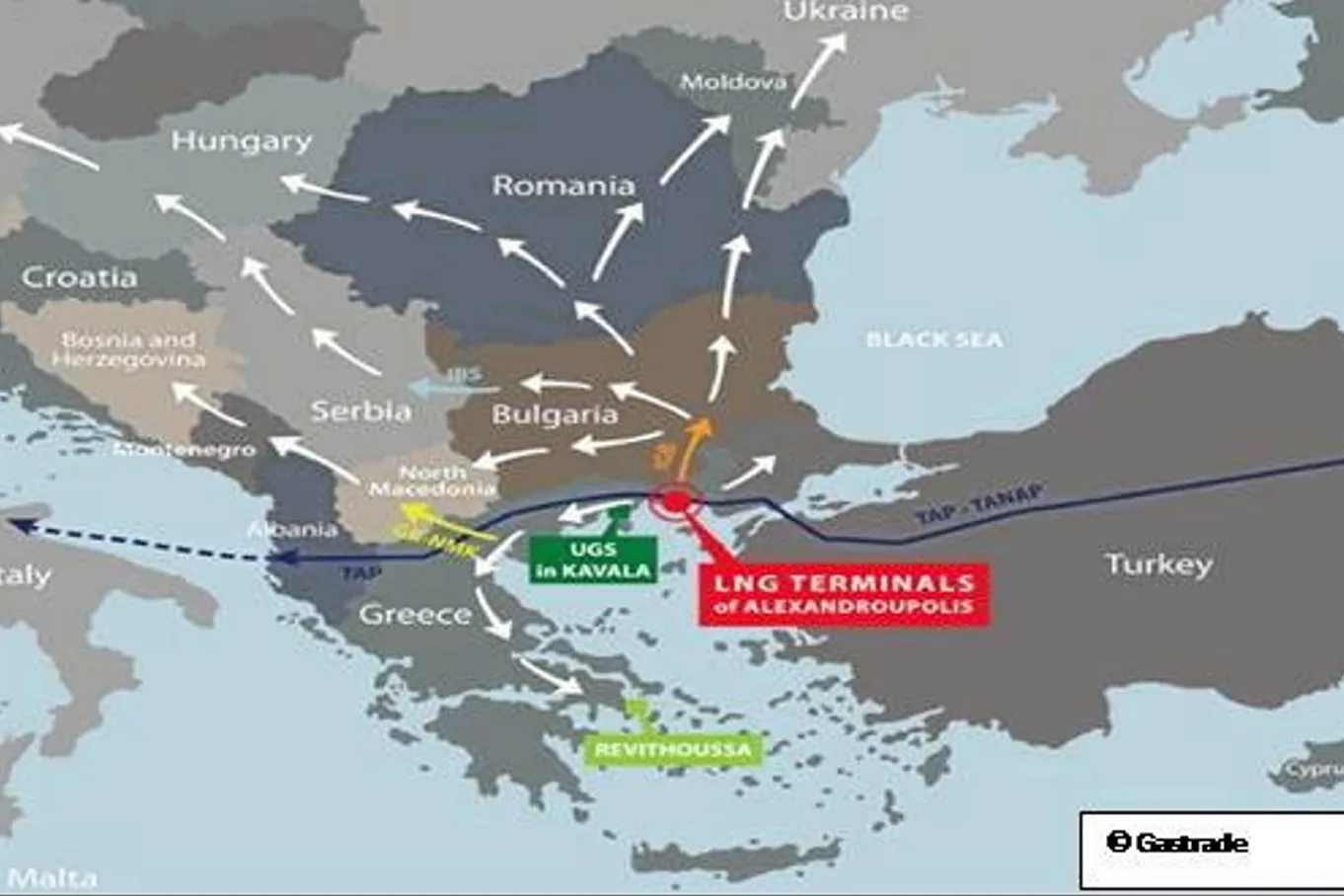
There is still no concrete clarity on the route of the “Vertical Corridor”. The Greek side is interested in the route from Alexandroupolis via Varna to Negru Voda in Romania. Initially, Greece proposed Alexandroupolis as the starting point, as it is a strategic hub for road, rail and maritime transport, as well as for the energy sector, and is also an important hub for liquefied natural gas.
But the corridor is not only infrastructure, but also a strategic necessity in terms of NATO military mobility and connectivity with Ukraine and Moldova, and their inclusion seems a logical and urgent act.
From a military point of view, it is more expedient to build the route as far as possible from the Black Sea, so as not to be vulnerable to possible Russian strikes. Therefore, the port of Thessaloniki and further through Sofia to the interior of Romania are also considered as a more likely starting point for the route. In view of the ongoing conflict in Ukraine, these transport supply lines are of particular strategic importance for NATO, which is why they are a priority for the Alliance. Europe is already adapting to new security challenges, and the corridor will allow troops, heavy vehicles and equipment to cross borders faster and more safely.
The “Vertical Corridor” is planned to be financed by both European funds and national funds of Greece, Bulgaria and Romania. The three EU countries are interested in absorbing as much EU resources as possible, taking advantage of the current uncertainty in connection with the war in Ukraine, which is why they are trying to accelerate the implementation of the project.
The Greek side has a traditional interest in Corridor No. 10 (Greece-Macedonia-Serbia-Hungary-Western Europe). However, since North Macedonia and Serbia are not members of the Schengen area, the flow of goods is very slow, especially during the summer months. Bulgaria and Romania, which are already part of Schengen, point to this advantage for focusing efforts on modernizing the Alexandroupolis-Burgas-Varna-Constanta corridor.
For Bulgaria, it is particularly advantageous to connect Corridor No. 8 (Albania-Kosovo-North Macedonia-Bulgaria) with the Alexandroupolis-Odessa (or Thessaloniki-Odessa) corridor.
In addition to the need to develop NATO military mobility, a driving factor for the corridor is also the US interest in transporting liquefied natural gas along the “Vertical Corridor” starting point in Alexandroupolis. The negotiations are based on the need to address the price disparities that hinder the prospects of the “Vertical Corridor”. The negotiations are not easy, as currently uncoordinated and increased tariffs in Greece, Bulgaria, Romania, Moldova and Ukraine make the “Vertical Corridor” an unattractive and expensive option for gas suppliers, limiting its competitiveness against Russian natural gas. The “Vertical Corridor” is, however, the only south-north gas pipeline that can deliver US liquefied natural gas to households and businesses in Southeastern Europe. The corridor could provide 5 to 8 million cubic meters of US LNG to the region.
The sixth meeting of the Partnership for Transatlantic Energy Cooperation (P-TEC), held in Athens on November 6, set a goal of putting the gas corridor into operation in 2026. The forum was organized by the US Department of Energy, the Greek Ministry of Environment and Energy, and the Atlantic Council’s Center for Global Energy.
Thanks to strategic investments in the Alexandroupolis terminal and the new gas infrastructure, the entire region will be freed from dependence on Russian natural gas.
The Athens forum last week also hosted a meeting on the energy triangle in the 3+1 format – Greece, Cyprus and Israel with the US.
During the forum, Greece also signed a contract with the US for the supply of LNG for the next 20 years. This will strengthen Greece’s role as an “energy hub” and “entry point” for US LNG.
The inclusion of the India-Middle East-Europe Economic Corridor (IMEC) framework in the “3+1” declaration signals an additional level of strategic intent. IMEC, officially announced at the G20 summit in Delhi in 2023, represents a counter-initiative of the West and the Global South against China’s “One Belt, One Road” initiative. The “3+1” repositions the Eastern Mediterranean as a critical link through which IMEC’s energy connectivity reaches European markets. In this framework, Greece appears not as a periphery but as a key node on the 3,730-km electricity highway that integrates renewable energy from India, the UAE and Saudi Arabia directly into the EU’s electricity grids, with an estimated economic impact of approximately $31 billion.
Photo: Gastrade