
Thewesternbalkans.
- Serbia. The High Representative of the European Union for Foreign Affairs and Security Policy, Kaja Kallas, began her second official visit to the Western Balkans in Belgrade on 21 of May.
Shortly after arriving in the Serbian capital, she met with Serbian President Aleksandar Vučić. Other meetings included those with Prime Minister Đuro Macut, Foreign Minister Marko Đurić, Minister for European Integration Nemanja Starović, and Speaker of the National Assembly Ana Brnabić, as well as with opposition parliamentary groups and students.
One of the key topics was EU enlargement and the renewed momentum for expansion, which is now one of the priorities. In the same priority, another main topic was the opening of Cluster 3 and the importance of harmonising Serbia’s legal framework with that of the EU.
Among the topics discussed were also Serbia’s relations with Russia, as well as normalisation with Kosovo and Metohija.
According to RT Balkan, at a meeting with Ana Brnabic, Kallas insisted on resuming dialogue with the non-governmental sector. In addition, the guest from Brussels was interested in the course of the election procedure to the Electronic Media Regulatory Authority (REM), which is one of the demands of the protesting students. “At the meeting in parliament, Kallas did not mention the protests in the country, as well as Vucic’s visit to Moscow,” different sources report.
At a meeting with the head of the European diplomatic service, the Serbian President, in turn, stressed that despite the fact that Belgrade is open to constructive dialogue with Brussels, the protection of the Serbian people in Kosovo and Metohija remains a top priority.
During the press conference Kaya Kallas pointed out three priorities:
She started with EU enlargement. “I am deeply committed to encouraging all the Western Balkan countries to really seize the current momentum that we have in enlargement.
“From my discussions with the Serbian political leadership, it is clear that EU membership remains a strategic goal“ she continued. „However, I want to emphasize that we need to see actions also to prove and support those words. There are no shortcuts for membership. Real progress must be made here in Belgrade, and the next steps are very clear. They include media freedom, combating corruption, electoral reforms. Reforms need to be real, not just ticking the box on the paper.
Kaya Kallas also addressed border European security concerns. Serbia faces a strategic choice on where it wants to be. Serbia’s European future depends on the values it chooses to uphold.
During the meetings with Serbian leaders there were also talks about Serbia’s relations with its closest neighbour. Kallas insisted that the normalisation of relations with Kosovo is not just improving ties. It is fundamental for Serbia’s European future. It is time to overcome the past and focus on the common future. In this connection she plans to invite the representatives from Belgrade and Pristina to Brussels as soon as possible to discuss the concrete steps forward.
Kallas addressed also the situation in Bosnia and Herzegovina. She stressed the importance of Serbia’s leadership and constructive role in supporting the country’s stability.
- In Kosovo Kaja Kallas met the caretaker Prime Minister Albin Kurti and the leaders of the main political parties and representatives of civil society.
During the press conference Kaja Kallas insisted that the Western Balkans is of strategic importance to the European Union. EU enlargement to this region is the most significant geopolitical project and it is also a personal priority for her.
“It is good that EU membership is supported by most people in Kosovo and across a wide political spectrum. Kosovo belongs to the European family, but there are no shortcuts for EU membership. Progress can only be achieved through sustained reforms” she said.
“The European Union Growth Plan for the Western Balkans is a major opportunity for gradual integration into a European Union single market, that is bringing prosperity to the people. So, Kosovo was the first to submit a reform agenda and it is well positioned to benefit from the Growth Plan”, she said.
Kallas encouraged all parties to break the political stalemates and swiftly form a government, so that Kosovo can profit from also the EU support. The formation of new parliament and government is essential for Kosovo’s stability, growth and also European future.
Kallas insisted that a key priority remains the normalisation of the relationship between Kosovo and Serbia. For her the two countries are equal partners at the table. Stability depends on dialogue, not confrontation.
“As a sign of our commitment, I can announce that the EU has begun to gradually lift restrictive measures introduced in June 2023. The decision opens the door for greater opportunities for Kosovo’s development and also closer ties with Europe. But it’s conditional on sustained de-escalation in the north” she said.
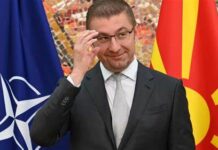
- Republic if North Macedonia. According to the press team of the EEAS, during the joint press conference in North Macedonia on 23 of May, High Representative/Vice-President Kaja Kallas underlined following priorities:
She addressed the people of North Macedonia, (not the Prime minister who was alongside with her) thanking for the warm welcome and declared that the European Union stands firmly with North Macedonia on its path to the European Union. Kaja Kallas also added that North Macedonia is the first beneficiary in the region of the Growth Plan for the Western Balkans and it is the first country in the region to sign a Security and Defence Partnership with the European Union.
North Macedonia belongs to the European Union and has a strong track record of aligning with European Common Security and Foreign Policy. This is very important to the EU, especially in these very turbulent times that we see major geopolitical shifts happening in the world.
Macedonian contribution to the EUFOR Althea in Bosnia Herzegovina is a clear example that the country is a reliable partner for the regional security. Kallas commends the strong efforts made by North Macedonia and its government on the reform agenda too.
But the road to EU membership is not easy, and her message was to stay on course and to take the next steps necessary towards the opening of the negotiations. It will also mean that the European Union will give North Macedonia even more support, be it in strengthening the rule of law, fighting corruption, or modernizing North Macedonians public administration.
Answering a question, Kaya Kallas aided: “We know that there are obstacles on the way, and we were discussing those as well to find really mechanisms to overcome these obstacles. So, of course, the Prime Minister can explain his ideas better, but I think there is definitely room to operate. I would not go into details if we move on. Then, of course, we will let also the press know”. And also – “Being very critical here, but what I want to say is that we still have hope that the plan A works. We are working for this. And if not, then we will move into the next phase.
Comments: In the last two months the Western Balkans have been the subject of particular attention from various leaders and institutions in the EU. Currently, it should be noted that the policy of the European Commission is sufficiently straightforward and fully in line with the messages conveyed by the President of the European Commission, Ursula von der Leyen, during her visit to the region in 2024. The EU’s priorities are also clearly outlined – expansion towards Montenegro and Albania (the top performers in the region), increased interest in Bosnia and Herzegovina primarily to prevent the failure of the model created by the Dayton Agreement, and support for the current state leadership in Belgrade. Kosovo remains at the end of the line, and at the moment there is more talk of stabilization than expansion. The question remains open with the Republic of North Macedonia, as the issue of constitutional amendment remains valid, and the messages from all European leaders who visited the country are one-sided – decisions made by the European Council as well as the engagements taken by the RNM must be implemented. For instant there is no plan B for the RNM.