Thewesternbalkans.
According to some Albanian and Greec media, the Albania Prime Minister Edi Rama attended the Delphi Economic Forum in Greece on a three-day working visit in April 21–23, where global leaders, business representatives, academics, and experts meet to discuss major international challenges and promote cooperation.
Rama met Greek Prime Minister Kyriakos Mitsotakis to strengthen bilateral relations. They focus on economic cooperation and progress on a new strategic partnership agreement between the two countries.
During the forum, the Albanian Investment Corporation (AIC) signs a Memorandum of Understanding with the Hellenic Corporation of Assets and Participations S.A. in a formal ceremony.
Speaking after the visit, Edi Rama was relatively optimist. He expressed confidence that Tirana and Athens could “address all outstanding issues” and even move toward signing a new Strategic Partnership document within the year. He praised Mitsotakis as a valued friend of Albania.
A Tirana times analysis reports that, despite repeated declarations of readiness, there has been no tangible breakthrough on the core issues that have defined the bilateral agenda for years. Base among them is the unresolved maritime boundary delimitation in the Ionian Sea, a matter that has oscillated between political commitments and legal uncertainty since the annulment of the 2009 agreement by Albania’s Constitutional Court.
According to the analysis, the gap between rhetoric and reality became clearer in the immediate aftermath of the Delphi Forum. Rama insisted that there was already an understanding with Athens to refer the maritime dispute to the International Court of Justice and expressed confidence that Albanian ambition is to complete it within this year.
The reaction from the Greek side was immediate and unequivocal – Athens moved quickly to distance itself from these claims. Greek officials further stressed that the discussion on maritime delimitation remains rooted in that legal setback and that it is the Albanian side that must take the necessary procedural steps to revisit the framework. The delimitation of maritime zones with Albania is no longer among the immediate priorities of Greek diplomacy. “Greece’s strategy focuses on the overall management of bilateral issues”.
The conclusion of the media is that this divergence in narratives underscores a broader problem: a widening gap between political messaging and diplomatic reality.
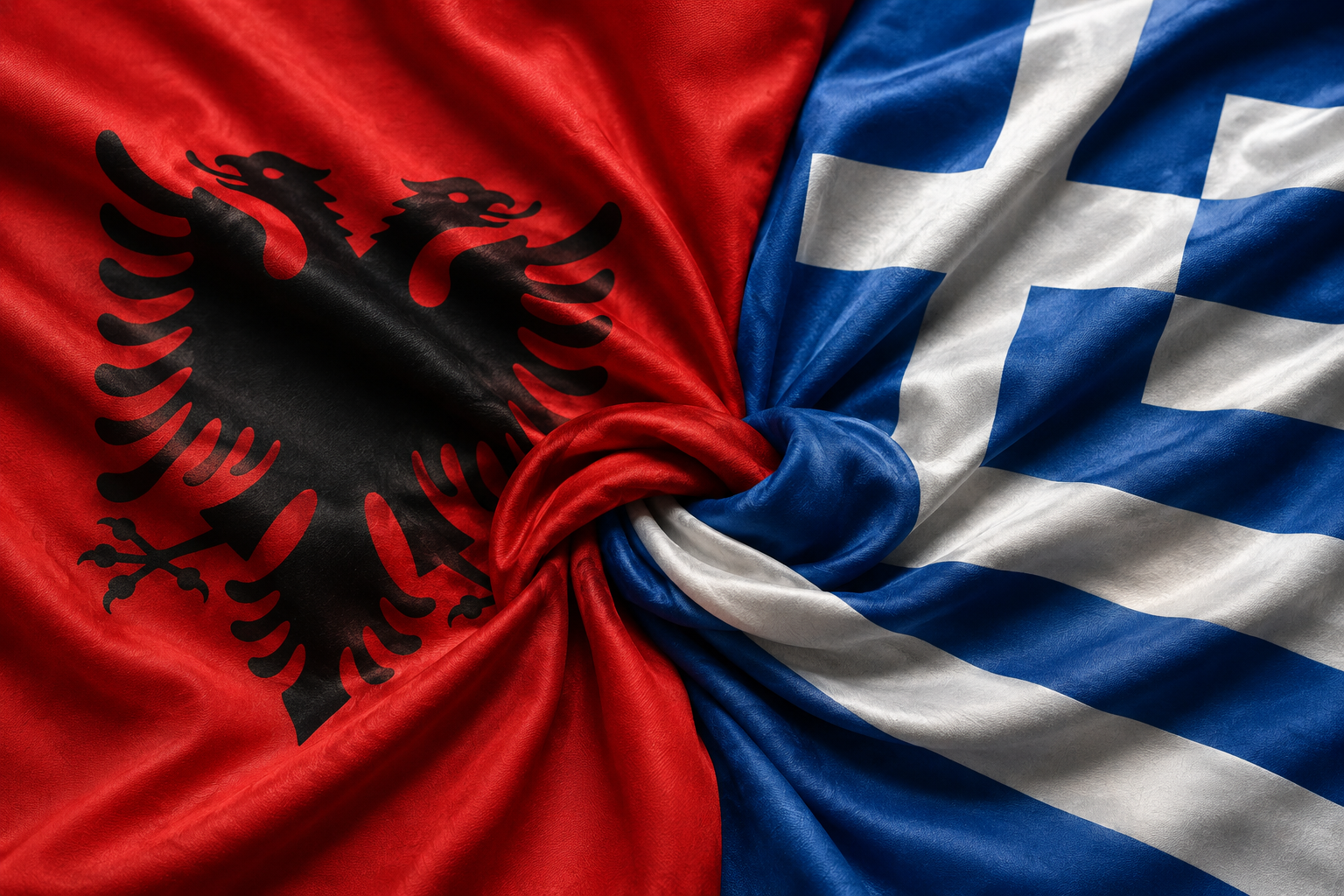
In practical terms, relations between Albania and Greece are best described as a status quo—if not a quiet freeze.
At the same time, rhetorical tensions have not been absent. Mitsotakis in a public interview earlier this year reminded that Albania’s path toward the European Union “passes through Greece.” The comment was both a diplomatic signal and a strategic reminder of Athens’ leverage within the EU enlargement process.
Greek media and analysts have been even more direct, often portraying Rama’s approach as overly performative, what one commentator termed a “no problem” narrative that glosses over deep structural disagreements. From this perspective, optimism about imminent agreements appears less like a reflection of diplomatic progress and more like a tool of political communication.
Prime Minister Edi Rama had also a meeting with Alexis Papahelas, editor-in-chief of the Kathimerini newspaper. Rama spoke about several topics of bilateral relations with Greece, but also about international developments. Asked if Albania aims to become an entry gate for American gas to Europe, Rama said: We have the chance to have this, our American friends are interested and helpful in this matter.
Asked about EU integration, Rama said that the Balkans are at their best moment and have never been closer to the EU.
The Prime Minister also had a special question about economic development and informality, for which he said that work is being done and that developments are very optimistic.
Comments: Since 1996, Albania and Greece have had a Treaty of Friendship, Cooperation, Good Neighbourliness and Security, the highest diplomatic instrument signed between the two states and still the most important bilateral agreement between them. Yet, at the same time, Greece’s so-called “law of war” with Albania formally remains in place, a fossil from another historical era that continues to cast a symbolic shadow over the relationship.
This contradiction helps explain why relations can be socially and economically dense, and in the same time politically frozen. The two countries have built practical economic cooperation and human connectivity over three decades, but their official diplomacy remains repeatedly pulled back by unresolved historical and symbolic disputes.
Albania and Greece are deeply interconnected through economic ties, migration and society. The presence of a large Albanian community in Greece and a Greek minority in Albania creates a dense web of human connections that far exceeds the level of formal diplomacy. In theory, this should make a strategic partnership easier to achieve.
Indeed, while Rama insists that “there are no problems that cannot be solved,” the absence of structured negotiations, agreed frameworks, or even a shared timeline suggests otherwise. Even the idea of a new Strategic Partnership document remains, for now, aspirational rather than operational.