Thewesternbalkans.
According to the European Council documents, on 26 of June 2025 was held the regular mid-year meeting of the state leaders of 27 countries – member of the European Union.
The final document, so cold Conclusions (in fact the European council decisions) is structured as follow:
UKRAINE. The European Council discussed the latest developments as regards Ukraine. The text set out was firmly supported by 26 Heads of State or Government. This support was not sufficient to be adopted as a part of the Conclusions. The European Council will revert to the issue at its next meeting.
MIDDLE EAST. The European Council addressed the situation and latest developments in the Middle East, in particular the catastrophic humanitarian situation in Gaza and the latest developments as regards Iran.
Thursday’s summit was the first time EU leaders addressed the EU-Israel trade pact review, flagging possible breaches over Gaza. EU foreign ministers have postponed any major decisions on Israel until mid-July.
The European Union has always been clear that Iran must never be allowed to acquire a nuclear weapon and that it must comply with its legally binding nuclear safeguard obligations under the Non-Proliferation Treaty. The European Union will continue to contribute to all diplomatic efforts to reduce tensions and to bring about a lasting solution to the Iranian nuclear issue, which can only be achieved through negotiations. The European Council welcomes the recent lifting of economic sanctions against Syria, and condemns the recent terrorist attack at the Mar Elias Church in Damascus.
The European Council reiterates the European Union’s support for the Lebanese people and welcomes the efforts of the new authorities to stabilise the economic and security situation.
EUROPEAN DEFENCE AND SECURITY. The European Council reiterates that Europe must become more sovereign, more responsible for its own defence and better equipped to act and deal autonomously and in a coordinated way with immediate and future challenges and threats, with a 360° approach. Russia’s war of aggression against Ukraine and its repercussions for European and global security in a changing environment constitute an existential challenge for the European Union. The European Council recalls that a stronger and more capable European Union in the field of security and defence will contribute positively to global and transatlantic security and is complementary to NATO, which remains, for those States that are members of it, the foundation of their collective defence.
EU countries regrouped after most of them agreed in The Hague (NATO Summit) to raise their defence expenditure to 5% of GDP. Von der Leyen and EU’s top diplomat Kaja Kallas were tasked with presenting a roadmap on financing in October
COMPETITIVENESS. The European Council exchanged views on economic developments. It underlines that boosting Europe’s competitiveness and further integrating the Single Market are key for sustaining Europe’s prosperity and social model, and will contribute to strengthening the EU’s global influence and position as a predictable, reliable and credible partner, including by enhancing the international role of the euro.
MIGRATION. The European Council encourages an intensification of work in particular on: the external dimension, notably through comprehensive partnerships; the implementation of adopted EU legislation and the application of existing legislation; the prevention and countering of irregular migration, including through new ways in line with EU and international law; efforts to facilitate, increase and accelerate returns, using all relevant EU policies, instruments and tools; the concepts of safe third countries and safe countries of origin; the fight against human trafficking and smuggling; visa policy alignment by neighbouring countries; as well as safe and legal pathways in line with national competences.
REPUBLIC OF MOLDOVA. The European Council looks forward to the first Moldova-EU Summit to be held on 4 July 2025. The European Council invites the Council to take the next steps in the accession process in line with the merit-based approach, with clusters being opened when the conditions are met. It takes good note of the assessment of the Commission that the fundamentals cluster is ready to be opened.
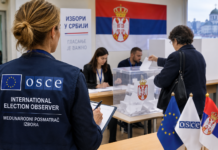
WESTERN BALKANS. The European Council held an exchange of views on the situation in the Western Balkans and recalls its previous conclusions. The European Union will continue to work closely with the Western Balkans and support their reform efforts on their paths towards EU membership. The European Council remains committed to advancing the gradual integration between the European Union and the region during the enlargement process itself in a reversible and merit-based manner. The future of the Western Balkans is in the European Union.
INTERNAL SECURITY. Organised crime, and terrorism, radicalisation and violent extremism, both online and offline, represent a major threat to European citizens and the security of Member States. The European Council calls on the EU institutions and the Member States to mobilise all relevant policy areas at national and EU level and to fully use all existing instruments to combat these phenomena. Following the presentation by the Commission of its communication on the development of a European Internal Security Strategy and the guidance provided in the Council, the European Council invites the EU institutions and the Member States to take further action where necessary, notably by strengthening law enforcement and judicial cooperation, including on effective access to data for law enforcement purposes, and by ensuring information exchange and through cooperation with third countries.
HYBRID ACTIVITIES. The European Council strongly condemns all types of hybrid activities against the European Union and its Member States as well as against its partners. It condemns in particular Russia’s continued hybrid campaign, including sabotage, disruption of critical infrastructure, cyber-attacks, information manipulation and interference, and attempts to undermine democracy, including in the electoral process. In this context, the European Council welcomes the adoption of additional listings under the framework for restrictive measures in view of Russia’s destabilising activities, and the broadened scope of this regime.
OTHER ITEMS. Black Sea. The European Council reaffirms the importance of security and stability in the Black Sea and welcomes the presentation by the Commission and the High Representative of the Joint Communication on the European Union’s strategic approach to the Black Sea region. The European Council, invites the Council, the Commission and the High Representative to take work forward swiftly.
Comments: Despite the rather extensive part in the Conclusions regarding the foreign policy, this European Council nonetheless focused on the main internal priorities of the Union – competitiveness, economy, the expansion of the Eurozone to Bulgaria, the fight against migration and organized crime, among others.
Regarding Ukraine, the blockade of the enlargement process by Hungary is becoming increasingly clear (obviously), but probably also by many other countries (in a less apparent way), and most likely by the end of the year Moldova will begin negotiations for accession on its own. For the Balkans, there are two sentences that are collective in nature and are rather placed to highlight the EU’s interest in the region, but do not give a clear indication of the actual status of the integration process of these countries.