Thewesternbalkans.
The Franco-German document was presented at the EU-Western Balkans summit in Tivat, Montenegro. The document is perhaps the most serious attempt in recent years to overcome the main problem of enlargement policy: candidates are waiting too long for membership without receiving enough tangible benefits, and the EU is losing influence in their favor vis-à-vis Russia, China, Turkey and other external factors.
Its main idea is “gradual integration” instead of an “all or nothing” approach. Until now, the model has been relatively simple: a candidate country meets the criteria and only after full membership does it gain access to all the benefits of the EU.
France and Germany are now proposing a different approach:
– access to parts of the Single Market even before membership;
– participation in European education, research and innovation programmes;
– inclusion in EU energy and industrial policies;
– participation in certain EU Council meetings and summits as observers without the right to vote;
– gradual integration through so-called “building blocks” (integration blocks), which are provided after concrete progress in reforms.
For countries such as Serbia, North Macedonia, Bosnia and Herzegovina, Albania, Montenegro and Kosovo, this is an important political signal that they will not be pushed off the agenda because of the acceleration of the process for Ukraine and Moldova. This is precisely one of the main goals of the document. Especially for Serbia and North Macedonia, which have been blocked for years for political reasons, the new approach offers the opportunity to receive concrete benefits even before final membership.
Among the positive aspects of the proposal are the real incentives for reforms. Until now, the promise of membership was too distant. The new model creates intermediate rewards for each reform. Preparation for membership is improved – candidates will start working in European policies years before formal accession.
The document is obviously also motivated by geopolitical considerations – reducing the influence of Russia and China. There is a growing belief in Brussels that if the EU does not integrate the Balkans and Moldova more quickly, the vacuum will be filled by other powers.
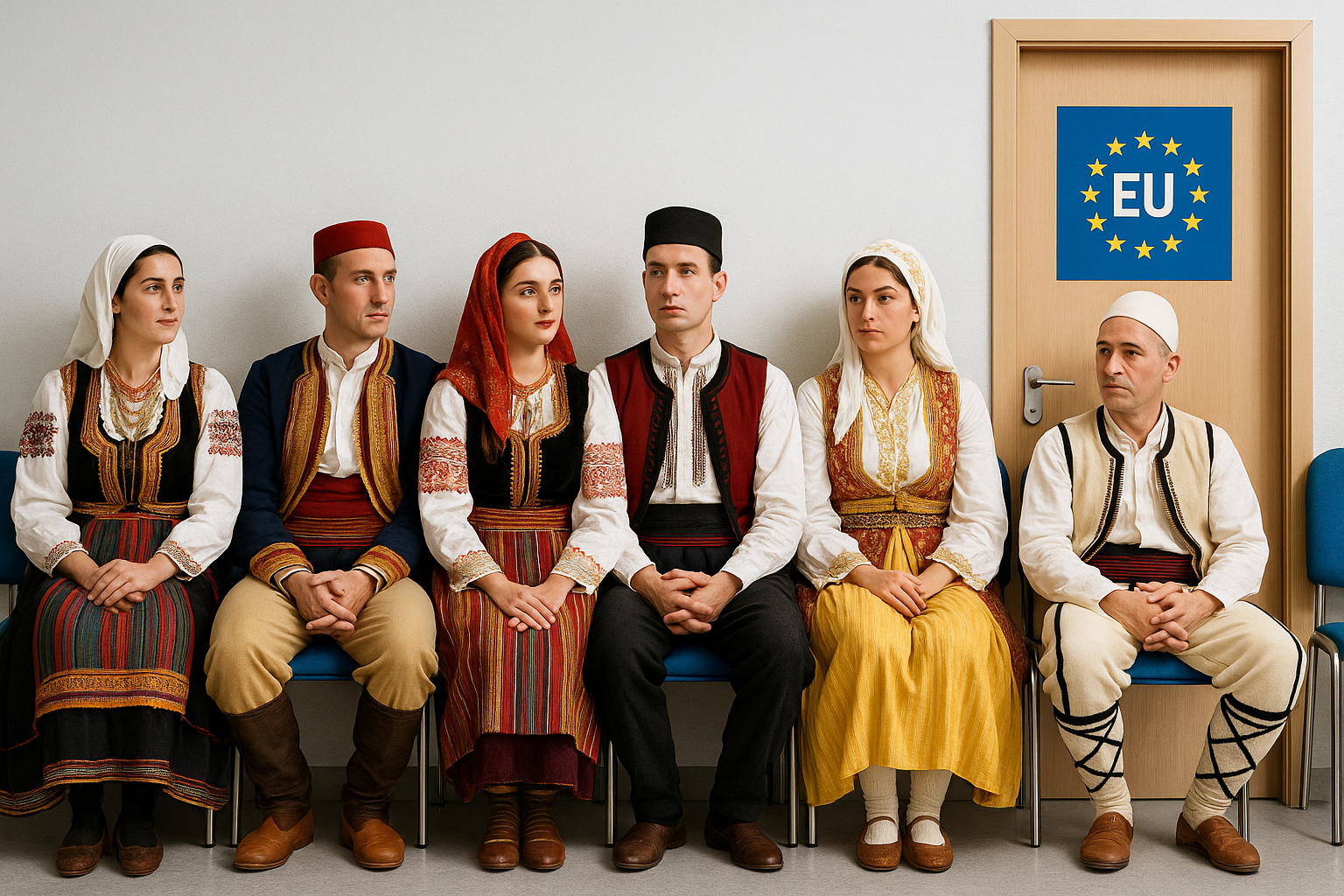
The main criticism of the proposed new enlargement model is the risk of an “eternal wait”. Many Balkan analysts are already warning that gradual integration could become a substitute for membership, rather than a step towards it. In Belgrade, Skopje and Podgorica, concerns are likely to arise that the EU is offering a new “waiting room” rather than real accession.
Among the potential problems are the unclear deadlines. The document talks about gradual integration but does not offer a specific date for membership. This could create new disappointments.
The criticism of the possibility of “second-class members” is particularly strong. Some ideas being discussed in parallel within the EU, including limiting the veto power of newly acceded countries for a certain period, could reinforce the feeling that new members are being offered a different status.
The Franco-German plan is a pragmatic attempt to revive EU enlargement in the face of the war in Ukraine and growing competition with Russia and China. The EU is gradually moving from the concept of “enlargement after reforms” to the concept of “integration through reforms”. The document offers more concrete benefits for candidates even before membership, but at the same time raises legitimate questions about whether gradual integration will not become a permanent substitute for full membership. For the Western Balkans, the most important question remains not whether they will gain access to individual EU policies, but whether this model will be accompanied by a clear political commitment and a timeframe for actual accession to the Union.
From a strategic perspective, the document shows that Germany and France are trying to take the political lead on the enlargement issue. France is no longer the main skeptic of enlargement that it was a few years ago. The document builds on ideas put forward last month by German Chancellor Friedrich Merz, when he proposed granting Ukraine associate membership in the EU and said that the slow pace of the enlargement process was frustrating for all parties involved.
For Moldova, the proposal is particularly important because it is making rapid progress in the negotiations but remains vulnerable to Russian pressure. Brussels is therefore looking for ways to provide tangible benefits even before membership.
Ukraine was not included in the latest Franco-German document because German and European analysts increasingly describe it as a “special case” rather than a regular candidate. The arguments are that Ukraine is at war, has a huge population, has a huge agricultural sector, and its future membership would have a much greater budgetary and institutional impact on the EU than any other Western Balkan country.
German Chancellor Friedrich Merz’s concept of “associate membership”, gradual integration into EU institutions and participation in meetings without voting rights, has been discussed for both Ukraine and Moldova and the Western Balkans. But Ukrainian President Volodymyr Zelenskyy has publicly criticized such an interim status, because according to Kiev it could become a substitute for full membership.
Ukraine is not the central element of the latest Franco-German initiatives not because Paris and Berlin are against Ukrainian membership. Rather, they are trying to solve two different problems at the same time:
– The Western Balkans – how not to be lost after two decades of waiting;
– Ukraine – how to be integrated more quickly, without the EU immediately taking on all the financial, institutional and political consequences of its full membership.
From the perspective of Paris and Berlin, Ukraine is not so much “excluded” as placed in a separate strategic category that requires a special model of integration.