Thewesternbalkans.
2026 – a turning point for Serbia?
Serbian President Aleksandar Vučić has already stated several times that early parliamentary elections in the country will be scheduled by the end of 2026. He also indicated the possibility of holding early presidential elections simultaneously with the early parliamentary elections, which were planned to be held in the spring of 2027. At the same time, A. Vučić rejects the possibility of changing the constitution so that he will be able to remain in office for another term. In any case, the end of Vučić ’s presidential term is approaching and political observers are asking themselves who will succeed him as president and when the change will actually take place. But the more curious question is – how will Vučić ’s own political career continue.
In an interview with the regional Serbian television network UNA (01.03.2026), the 56-year-old Serbian president rejected the possibility of becoming a political pensioner. Vučić’s behavior during the interview (as well as that of the presenter himself) displayed an emphasized comfort in the studio of the relatively new television station, which is associated with circles around the president of Serbia and the president of Republika Srpska (some media outlets even call it “Dodik’s TV”). Therefore, Vučić spoke out, stating that he has been in power for a long time and is proud of the results of his work, but has not yet made a decision about his further political role.
Diplomatic observers in Belgrade predict that the possible simultaneous holding of parliamentary and presidential elections is a good time for A. Vučić to take the post of prime minister, and for a candidate nominated and supported by him, respectively by the Serbian Progressive Party (SPP), to be elected president.
Vučić himself admitted in the aforementioned interview that he thinks about the next president every day and is already selecting possible candidates for the post of head of state, but a final decision has not yet been made. “We will have a very good candidate for president. There are two or three people who can run. I think and consult, sometimes I send false signals to see the reaction,” Vučić confessed in the television interview.
Of course, it is still too early to make predictions, but Vučić would not be Vučić if he did not plan his moves around the clock. The Serbian president likes to speculate on his chess abilities – he participated in chess competitions for children and later played in exhibition chess matches.
Peculiarities of the Serbian system and Vučić’s game
Vučić’s admission that he thinks and consults about presidential candidates every day, although shared in a little-known regional media outlet, is a signal that the bidding for the post has already begun. According to the constitution, Vučić cannot run for president for a third time, but he does not need to – Serbia is a parliamentary republic and the president is not that important.
Vučić’s current unshakable leadership is due to his personality and the autocratic style of governance he has imposed, which does not allow any important decision in the country to be made without receiving the prior approval of President Vučić, which is due to the fact that he has completely taken over the structures of the ruling SPP, and people loyal to him personally have been appointed to important positions in the state.
In the upcoming early parliamentary elections, Aleksandar Vučić plans for the ruling Serbian Progressive Party to win and – in the event that it does not have a full majority – the formation of a coalition government, which he will head as prime minister. An example to follow in this regard is the case of Vladimir Putin, who nominated Dmitry Medvedev as his successor to the presidency, while he himself became the prime minister of the Russian Federation. The parallel with neighboring Bulgaria, where Rumen Radev was president of his country for 9 years before resigning to enter the executive branch, will also be interesting. Vučić himself was already prime minister of Serbia – from 2014 to 2017, before being elected president.
When predicting Vučić’s political moves, however, one should always keep in mind that he does not stick to his word and is not afraid to break his promises. In a series of public statements in 2025, he spoke of early elections by the end of the year, but this did not happen. Some international observers believe that Vučić may also renege on his promises of early elections by the end of 2026. The other option is, with his inherent cynicism, to schedule them so soon that his opponents do not have enough time to react. The regular local elections in nine Serbian municipalities on March 29, 2026, may serve as a certain indicator of the direction of Vučić’s future decisions.
It is also not at all certain that early presidential elections will be held simultaneously with parliamentary elections. Vučić remembers very well the mistakes of Slobodan Milošević and Boris Tadić with holding presidential and parliamentary elections simultaneously. Milošević lost the presidential elections in 2000, and Tadić – in 2012. This phenomenon, characteristic of Serbian political reality, may force Vučić to retain his presidential mandate until the end.
The profile of the presidential candidate
Whenever the presidential elections are held, Vučić does not hide the fact that he will be the person who will nominate the future “Serbian Medvedev”. The presidential candidate will most likely have to meet two main criteria: first, to be absolutely loyal to Vučić and second, to be able to defeat the opposition candidate.
Vučić will most likely wait to see the candidate of his opponents and then he will nominate a counter-candidate. He will try at the last possible moment, even a month before the elections, to pull a winning card from his sleeve by nominating a presidential candidate who will be able to fight head-to-head with the opposition candidate.
Possible presidential candidates
The candidacy for pro-Russian president is best suited to Ivica Dacic, chairman of the Serbian Socialist Party, deputy prime minister and minister of interior. The deteriorating health of the 60-year-old Dacic (recent hospitalization with bilateral pneumonia, heart problems, long-standing diabetes) greatly reduces his chances.
Vučić would prefer to see Miloš Vučić as president, who, however, had to leave the prime minister’s chair in January 2025 due to the radicalization of anti-corruption protests following the incident in Novi Sad. He is extremely loyal to Vučić and is now waiting for the development of events as chairman of the ruling Serbian Progressive Party and advisor to the president. Meanwhile, at the beginning of this year, a trial balloon was released with the name of M. Vučević for a high state post – as the future chairman of the Security and Intelligence Agency (BIA), the Serbian intelligence and counterintelligence service.
According to international experts, however, Miloš Vučević is too impersonal a figure and too party-bound a candidate for president. According to some experts, the profile of the current Prime Minister Đuro Măsut is more suitable – a non-partisan professional with a career outside politics, who would receive greater public support, including from the opposition-minded part of society.
Also on the bench of the ruling SPP with presidential candidates is Ana Brnabić, Speaker of the Parliament, as well as Sinisa Mali, First Deputy Prime Minister and Minister of Finance. Political observers also note the name of Milica Đorđević-Stamenkovski (35), Minister of Labor, Employment, Veterans and Social Affairs. The chairwoman of the nationalist party Zavetnica was a long-time opponent of Vučić, but later became his coalition partner. She could be supported by both Vučić (if he decides that he can control her in the long term) and the national-conservative opposition in Serbia.
The opposition candidates
However, even less is known about the candidates of the opponents of the government. The Serbian opposition is traditionally highly fragmented and the individual opposition political parties are marginalized. The two main camps – pro-European liberal and national-conservative – cannot produce potential leaders who would oppose Vučić.
Prominent long-time opposition leaders, such as Dragan Djilas, leader of the Freedom and Justice Party, former general Zdravko Ponos, leader of the Serbia Center (SRCE) party, and Vuk Jeremic, founder and chairman of the People’s Party (until 2023), have already become tired of the public (the latter two have already been unsuccessful presidential candidates).
Popular patriotic figures such as tennis star Novak Djokovic or film legend Emir Kosturica, who have recently positioned themselves as opponents of Vučić, supporting anti-corruption protests, will be encouraged to run. In Serbian conditions, both are eligible candidates, but the question is what they will do after the election.
The opposition to the president has a problem with the fact that party leaders have limited credibility. Therefore, non-partisan public figures are periodically discussed – for example, university rectors, famous professors, popular lawyers. It is in this category that Vladan Đokić, the rector of the University of Belgrade, who became one of the public speakers of the university community during the protests and university blockades of 2024–2025, falls. He gained popularity among a part of the opposition public and began to be perceived as a public figure outside party control. Ideas periodically appear in the Serbian media and political analyses that he should appear as a public candidate of the opposition and participate in an expert or transitional government, especially since his second and last term as rector expires in 2027.
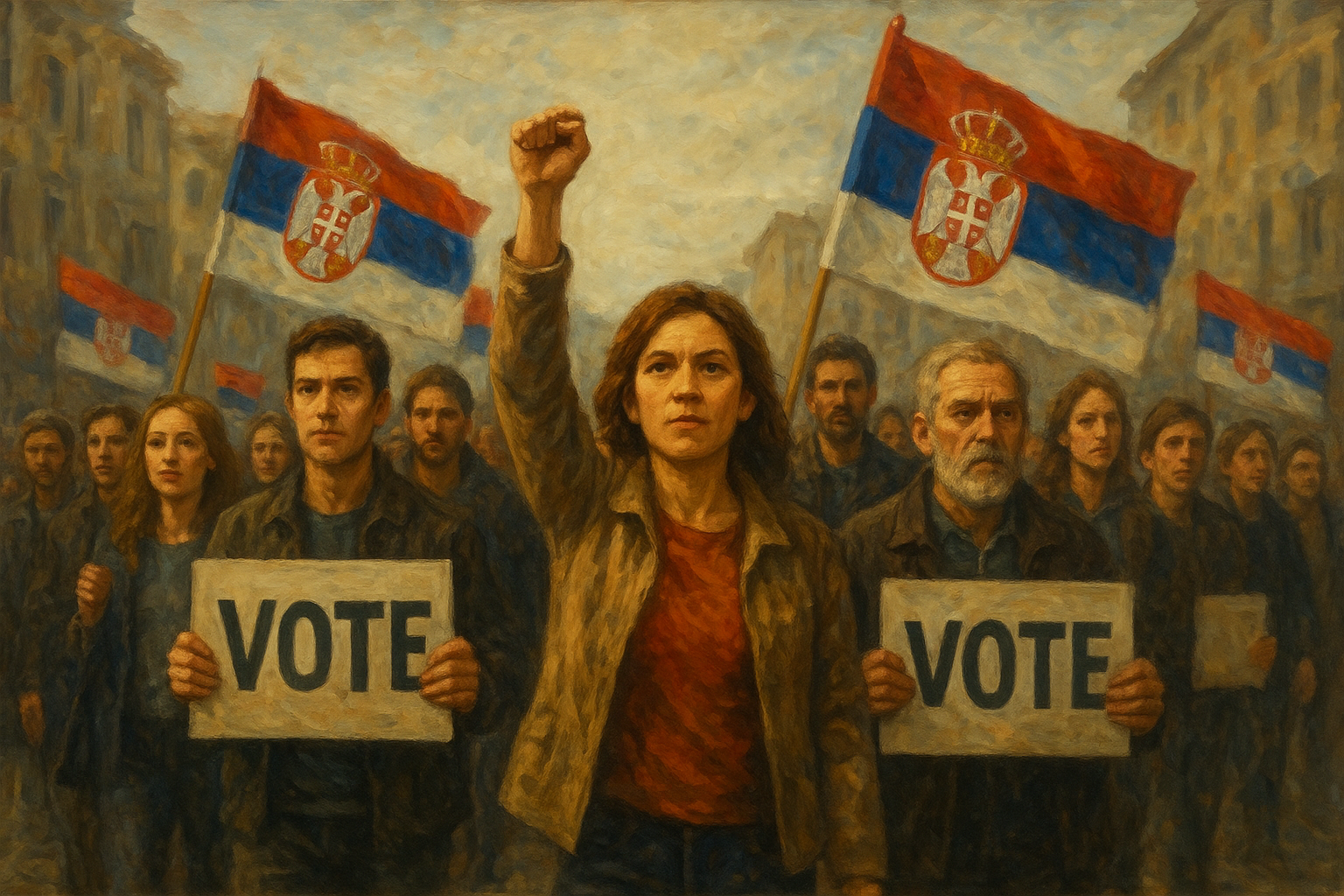
In the last decades, dominated politically by Vučić, Serbia has not had a strong prime minister. Despite the anti-government protests that have been going on for more than a year, the Serbian power system remains very resilient. The protests, catalyzed by the incident at the Novi Sad train station, are currently not massive, but the protest potential has not disappeared. The radical militant wing of the protesters is preparing for a decisive battle immediately after the elections: whatever the election results are, they will be contested by the radical protest structures with decisive, and possibly violent, means. The situation immediately after the elections will be a critical point for the political stability of Serbia, especially against the background of the deep division in Serbian society.