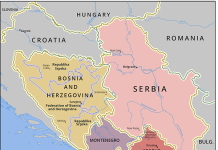

Thewesternbalkans.
A deal for Serbia to buy 12 French Dassault Aviation Rafale fighter jets was signed by French President Emmanuel Macron during a visit to Serbia in August 2024.
Serbia and other Balkan countries are in the process of replacing and modernizing their aging weapons arsenals dating back to the Cold War. Serbia’s western neighbor, Croatia, also bought 12 Rafales, while its eastern neighbor, Bulgaria, opted for American F-16. Serbia is particularly sensitive to its air security, given its historical experience of heavy bombing during World War II by Germany and in 1999 by NATO.
The Rafale purchase was necessary to build up Belgrade’s air power, as the 14 Russian MiG-29s used by the Serbian Air Force are nearing the end of their service life. The decision to purchase a French-made military aircraft is not only a choice of military-technical parameters, but also takes into account geopolitical elements. France has traditionally been Serbia’s best Western friend. The war in Ukraine has hindered military-technical cooperation with Russia, and partnerships with rival powers are in line with Serbia’s multi-vector foreign policy. Belgrade sees the purchase of weapons from France and the US, as well as from China and Russia, or from new partners such as the UAE, as a kind of insurance.
For Serbian President Aleksandar Vučić, the purchase of the expensive French aircraft (2.7 billion euros) is a way to show the local public that he cares about the army, which is one of the pillars of the political government that has been shaken in recent months.
The Rafale deal also has other (geo)political dimensions. It is a cornerstone of Serbian-French military relations. The contract with the French company places the Serbian Air Force in strategic dependence and sets the trajectory for joining NATO. Serbia, together with Dassault Group, will produce parts for the Rafale, according to an bilateral agreement. But Serbia is not yet a NATO member, so the Rafale fighters will not have access to all the technical applications, as is the case with the fighters delivered to Croatia, which is in NATO. Given Serbia’s susceptibility to Russian and Chinese influence, Paris has warned Belgrade not to share Rafale-related technology with Russia and China.
Serbia has French weapons – Mistral missiles, a portable infrared air defense system and the GM-400 long-range surveillance radar from the French company Thales. But Belgrade’s military arsenal also includes the Russian Pantsir S1 rapid-fire anti-aircraft missile system, Chinese CH-92A drones and Chinese FK-3 air defense systems. The question is how these different pieces of equipment will be integrated into the same system, and especially how to protect French technology from Chinese data mining methods.
Lay commentators usually claim that Chinese systems cannot “talk” to Western ones, but a Serbian officer told a Chinese media outlet that the FK-3 air defense system is fully integrated into the command system and integrated with other (and Western) modern weapons in the Serbian air defense system.
After the Serbian parliament approved the financial and technical architecture for the purchase of 12 Rafale fighters on June 16, the Serbian Air Force must also begin logistical preparations for their arrival.
The new fighters are due to arrive at the Serbian air base in Batajnica, about 20 km from Belgrade, in 2028. To this end, the “graveyard” of old Soviet aircraft that have fallen into disuse and are stored on the base has already been cleared. Much intensive work still needs to be done, as Batajnica currently has only two of the necessary large protective hangars, each of which can accommodate only one Rafale. Serbia is planning to build new hangars, as well as the reconstruction of existing installations and maneuvering areas in connection with the acquisition of the Rafale. Egypt is providing assistance for the construction of the hangars planned not only in Batajnica, but also at the military airfields in Ladzhevci (near Valjevo) and in Niš.
Some issues related to the physical security and protection of the Batajnica base, which is located in close proximity to two settlements – the town of Batajnica and the town of Nova Pazova, also need to be resolved.
Serbian pilots, who have so far flown the Serbian MiGs, must quickly undergo the training necessary to fly the fighters according to NATO standards. The simulators have already been received from France.
So far, only two Rafales of the French Air Force have flown over the skies of Belgrade during the grand military parade of the Serbian Armed Forces on September 20.