- Executive Summary
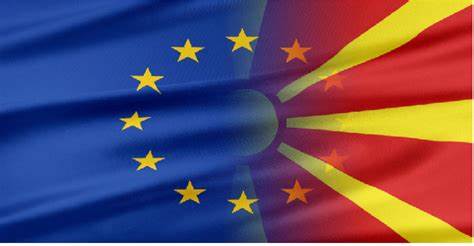
The 2025 Enlargement Package from the European Commission (EC) presents a balanced yet critical appraisal of the Republic of North Macedonia’s accession track. The screening of all six clusters, completed by 7 December 2023, is a key milestone. However, substantive advances on essential reforms remain limited. The EC reaffirms North Macedonia’s strong alignment with EU foreign and security policy—especially regarding Russia’s war in Ukraine—and its engagement in regional cooperation. Yet institutional bottlenecks, delayed constitutional amendments, and weak progress on the rule of law and anti-corruption maintain the country at a “moderate/lower-mid preparedness” for accession.
North Macedonia remains one of the most advanced Western Balkan aspirants, yet it also serves as a cautionary example of how reform momentum can stall post-candidate status. It is therefore essential to monitor: (a) the pace of constitutional reform, (b) the adoption of the so-called “fundamentals” cluster, and (c) the country’s ability to maintain reform credibility ahead of potential opening of negotiations.
- State of the Process & Key Milestones
All six “screening sessions” covering the acquis clusters were completed on 7 December 2023; their reports were presented to the Council.
North Macedonia continues implementing the Stabilisation & Association Agreement (SAA) and participating in relevant joint bodies.
The EC emphasises that while institutional structures for EU integration are in place, permanent and decisive steps are still needed to accelerate reform beyond the Reform Agenda.
Notably, the Council conclusions of 18 July 2022 require constitutional amendments to ensure representation of “other peoples,” including the Bulgarian minority in North Macedonia—these steps remain outstanding.
- Institutional & Governance Reforms
Parliament & Political Polarisation
The EC finds that the Assembly “exercises its powers in an overall effective way,” yet persistent political polarisation delays reform adoption and long-overdue appointments. The lack of substantive progress on constitutional amendments remains a crucial deficiency.
Administrative Capacity & Negotiation Structures
While structures for coordination exist, the EC highlights the need to further strengthen negotiating structures, ensure effective coordination across ministries, and develop EU acquis-related expertise across the administration.
Judiciary, Fundamental Rights & Anti-Corruption
The country is assessed at a “between some and moderate level of preparation” for judiciary and fundamental rights; no progress was recorded on anti-corruption.
Corruption remains prevalent; the Ombudsman institution has new appointments pending (one Ombudsman plus eight deputies).
Media freedom remains an issue: the legislative framework is not fully aligned with the European Media Freedom Act (EMFA), and progress on the Law on Media is limited.
- Economic Criteria & Market Readiness
Functioning Market Economy
North Macedonia is at a good level of preparation for a functioning market economy, yet progress is limited.
Real GDP growth accelerated in 2024 driven by consumption and investment; however, external position weakened, inflation returned, and fiscal deficit exceeded planned levels.
Capital expenditure management remains weak; informal economy formalisation stalled.
Banking sector resilient, credit growth strong, labour market improved, but structural issues (low participation, emigration, gender gap) persist.
Capacity to Cope with Competitive Pressure
Some progress in vocational education and digitalisation, but public procurement and statistics are only moderately prepared.
Company law and intellectual property law remain under-prepared; competition policy, financial services continue to lag.
- Internal Market & Free Movement
Free movement of goods: moderate preparedness, no progress recorded.
Workers: early stage of preparation; no progress.
Establishment/services: moderate preparedness; limited progress.
Capital: between moderate and good; some progress (e.g., SEPA membership in March 2025).
Company law/media sectors continue to require alignment; competition and financial services remain moderately prepared.
- Green Agenda, Connectivity & Agriculture
Transport: moderate preparedness; progress seen on multimodal node Trubarevo, but alignment to TEN-T still incomplete.
Energy: moderate preparedness; some progress on transition planning, yet dependence on coal remains and alignment to renewable acquis is slow.
Agriculture & rural development: moderate preparedness; some IPARD II/III action, yet further progress needed.
Environment/climate: some level; limited enforcement of legislation.
- External Relations & Foreign, Security and Defence Policy
North Macedonia is assessed at a good level of preparation in external relations and foreign, security and defence policy.
It fully aligns with EU restrictive measures on Russia, participates in EU crisis missions, and in November 2024 signed a Security & Defence Partnership with the EU.
Existing bilateral agreements (Prespa with Greece; Treaty of Friendship, Good Neighbourliness & Cooperation with Bulgaria) are acknowledged, but implementation needs renewal.
- Overall Assessment & Commentary
The EC report presents a dual narrative: on one hand, North Macedonia is acknowledged as a credible EU aspirant with solid alignment in foreign policy; on the other, it remains stuck in the “pre-accession lag” where establishment of structures has outpaced their effective functioning. The unmet constitutional amendments are a key blocking point for opening negotiations, especially the “fundamentals” cluster.
The leadership of Prime Minister Dimitar Kovačevski (former) and now under Hristijan Mickoski—assuming he leads the next government—face a delicate balancing act: deliver visible reform progress, strengthen institutions, and maintain political consensus. Failure to do so could stall accession momentum and undermine both domestic reform legitimacy and external support.
- Conclusion
North Macedonia’s road to EU accession remains open, but the recent EC report makes clear that passage is not automatic. The country stands at a critical transition point: moving from candidate status into genuine, sustained accession reform.
Without accelerated and credible reform delivery, the risk is that the accession track becomes stagnant.
The report of the European Commission is quite objective and critical regarding the processes that have taken place over the past year in the Republic of North Macedonia. The contradictory messages from Prime Minister Mickoski have led to a situation where even in sectors where North Macedonia could make more significant progress, they remain at a level of mediocre preparation. The EC quite naturally (and as expected) continues to uphold the decisions adopted by the EU Council in July 2022 regarding the criteria for starting real accession negotiations with North Macedonia. And here, no political gymnastics on the part of Prime Minister Mickoski help.
On the other hand, we should seriously reflect on the position that Prime Minister Mickoski has established in his country, precisely on a nationalist basis. His recent overwhelming victory in the local elections is sufficiently indicative in this regard.