Thewesternbalkans.
Iran’s recent strikes on targets in Cyprus show that Iran is not limited to a specific geographic location when striking centers associated with its adversaries and is expanding its operational capabilities beyond the region.
Amid rising regional tensions, the press service of the Islamic Revolutionary Guard Corps (IRGC) is considering the possibility of an Iranian attack on sites that Tehran considers to be linked to “hostile activity.” The threat includes the headquarters of the Mojahedin-e-Khalq (MEK), located at the Ashraf-3 base in Albania (or as it is also called in the official Iranian press, “Monafeghin,” a Quranic term from the Arabic munafiqun, meaning “hypocrites”).
What is the Mujahideen Organization of Iran?
The Mojahedin-e-Khalq, also known as the People’s Mojahedin Organization of Iran (PMOI), is the largest member, core, and main driving force of the National Council of Resistance of Iran (NCRI), a coalition of Iranian opposition groups that considers itself the parliament abroad of the Iranian opposition and the dissident movement of Iran.
The MEK was founded in 1965 as an Islamic political movement with socialist tendencies, opposing the rule of Shah Mohammad Reza Pahlavi. In the 1970s, it carried out armed attacks against the monarchy and targeted US interests in Iran.
The organization initially supported Ruhollah Khomeini and the Islamic Revolution of 1978–1979. However, relations with the new spiritual leadership quickly deteriorated. The group was banned and many of its members were arrested or fled the country, while it went into exile and continued its opposition activities from abroad.
In the 1980s, MEK moved to Iraq, where it operated from bases provided by the government of Saddam Hussein. From Iraqi territory, it launched military operations against Iran during the Iran–Iraq War, a move that remains deeply controversial among many Iranians and has fueled long-standing resentment of the group.
Following the ouster of Saddam Hussein in 2003, the group’s position in Iraq became increasingly precarious. Under pressure from the Iraqi government and amid security concerns, its members were gradually relocated outside the country, culminating in their relocation to Albania.
The United States designated MEK a foreign terrorist organization in 1997, citing its past involvement in violence. However, after years of legal and political lobbying, the US State Department removed the group from its list of terrorist organizations in 2012, saying it had renounced violence and helped close its paramilitary camps in Iraq. The MEK was classified as a terrorist group by the UK until 2008 and by the EU until 2009. The group itself claims that it was blacklisted only because of the West’s desire to appease Tehran and denies all charges of terrorism.
Recent protests in Iran and Iranian opposition abroad
Outside Iran, the two largest opposition groups are the monarchists and the MEK. Leaders and members of both groups have lived in exile since the overthrow of the Pahlavi dynasty in 1979. They are also fiercely competitive with each other.
NCRI officials say the MEK was actively involved in the January protests and its resistance units organized resistance against the repressive forces. A significant number of MEK activists were among the 3,000 killed by security forces. However, the protesting masses chanted the name of the Shah’s crown prince, not the NCRI chairman.
In addition to its legitimacy problems within Iran, the MEK has also had problems with recognition abroad, particularly in the US and the EU. Despite the massive lobbying efforts of the National Council of Resistance of Iran in the European Parliament, leaders of the Mujahedin-e Khalq (MEK) and the National Council of Resistance of Iran (NCRI) are not among the eight Iranian opposition figures invited to speak at a parliamentary session. The list compiled by the European Parliament’s Foreign Affairs Committee is headed by Reza Pahlavi, the exiled son of the last Shah of Iran. He is a beloved figure in the Iranian diaspora and is supported by the US.
The MEK and NCRI group have some support among Republicans in the US (former Trump allies Mike Pompeo, Mike and Pence’s Rudy Giuliani) as well as in some European far-right circles, but other politicians consider them too undemocratic, too Islamist or fringe.
But the main problem for the MEK may not come from Tehran, but from Israel and the current American administration, who do not want someone unsuitable standing in the way of their favorite in a possible regime change in Tehran.
What is the MEK looking for in Albania?
About 3,000 MEK members have been in the country since the Albanian government agreed to accept them in 2013 at the request of the United States and the United Nations. They are housed in a fortified camp in Manze, a small village in central Albania, near the capital Tirana. The move followed years of insecurity for the group’s cadres in Iraq, where they were previously stationed.
In 2022, Albania was hit by a major cyberattack, which Tirana said was carried out by the Iranian Foreign Ministry as a punitive measure for sheltering the large Iranian opposition group. As a result, Albania severed diplomatic relations with Iran that same year. In 2023, Albanian police raided the Ashraf-3 base on suspicion of illegal activities violating the agreed terms for hosting the MEK in Albania. One person was killed and many were injured in the police operation.
The Albanian perspective
Albanian media regularly report on both the protests in Iran and the MEK in Albania. For their part, MEK members in Albania are active on social media, sharing posts and photos related to protesters who lost their lives and MEK members they claim were killed during protests.
Albanian Prime Minister Edi Rama, who has strongly supported Israeli and US strikes on Iran, has called for Iran’s Islamic Revolutionary Guard Corps to be designated a terrorist group and has urged European countries to follow suit.
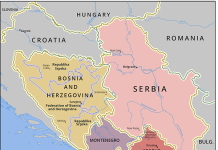
For now, the geographical expansion of Iran’s strikes to the Western Balkans, and Albania in particular, should be perceived only as a theoretical possibility and part of the KZIR propaganda war. However, Tirana’s rhetoric and actions position Albania as the most determined regional supporter of the removal of the Iranian regime.