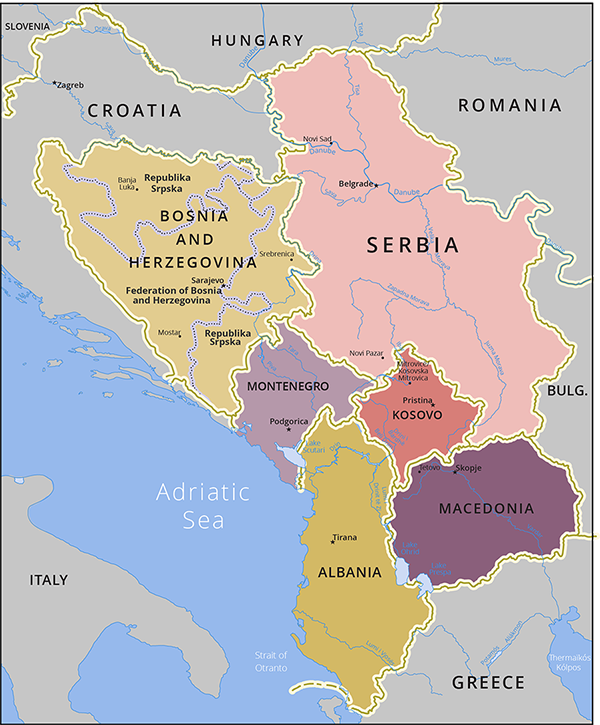
Thewesternbalkans.
The reactions of the Western Balkan countries to the tensions and military actions between Israel, the United States, and Iran generally follow their foreign policy orientation – mainly towards the EU and NATO.
Most countries in the region are officially calling for de-escalation and a diplomatic solution. NATO members and countries with a clear Euro-Atlantic orientation are more likely to support the positions of the US and Israel. Serbia is striving for a more balanced rhetoric.
Here is a summary by country:
Albania has traditionally maintained a strongly pro-Atlantic stance. Tirana expresses solidarity with the United States and Israel, supports Israel’s right to self-defense, and condemns Iranian actions that are perceived as destabilizing the region. Tirana shelters Iranian opposition members, which would allow it to develop priority relations with a possible new regime in Tehran. Albanian Prime Minister Edi Rama said that Albania stands firm with Israel and with the peace-seeking brotherly Arab countries, as well as supports the United States under the leadership of President Donald Trump in militarily supporting Israel.
“Albania has faced firsthand the barbaric face of the Tehran regime through its cyber aggressions against our country. For us, this is not abstract geopolitics. It is national security, moral and legal clarity,” he aided.
Edi Rama declared that Iran’s Islamic Revolutionary Guard Corps should be officially designated a terrorist organization and saying Tirana would move to list it as such, citing Albania’s own experience with Iranian-linked cyberattacks and its national security concerns.
He then signalled specific steps Albania intends to take and urged European governments to follow. “Albania will act accordingly. We will call the Revolutionary Guard what it is and list it among terrorist organizations, and we call upon our European friends to do the same,” Rama said.
Kosovo is one of the strongest supporters of the United States in the region. In such conflicts, Pristina usually demonstrates firm support for Israel and American policies.
Kosovo President Vjosa Osmani issued a strong statement of support that framed the strikes as a turning point for Iran’s population and reaffirmed Kosovo’s alignment with the United States and its partners.
“The hour of freedom has come for the people of Iran, thanks to the leadership of the United States and President Donald Trump. As always, the Republic of Kosovo unwaveringly stands with the United States and its allies in defending freedom, peace, security, and stability,” Osmani said.
Kosovo’s Ministry of Foreign Affairs and Diaspora issued its own full statement, describing Iran as a destabilizing force and backing Washington’s approach.
“We stand with President Donald Trump in his effort to deter regimes that threaten free peoples, to protect global stability, and to support the legitimate aspirations of the Iranian people for freedom, dignity, and democracy,” the Ministry said.
North Macedonia also follows the EU and NATO line. The government calls for de-escalation but expresses understanding for the Israeli position.
North Macedonia’s foreign minister, Timčo Mucunski, publicly backed the United States, while emphasizing diplomacy and deterrence and expressing solidarity with Gulf partners. “We stand with our American allies in confronting destabilizing threats in the Middle East,” he said.
Minister Mucunski aided that North Macedonia’s embassies and consular teams in the region were working to support citizens and provide assistance, and condemned Iranian attacks on Gulf states. “We also reaffirm our full solidarity with our partners in the Gulf. Attacks against GCC countries by Iran are unacceptable and risk wider regional escalation,” he said.
Montenegro, as a NATO member, generally aligns itself with the EU and US positions. It supports a diplomatic solution, but also recognizes Israel’s right to security. Podgorica officially condemns Iran’s actions and calls for peaceful diplomatic de-escalation, while adhering to the common position of the EU and NATO. The Ministry of Foreign Affairs of Montenegro has issued an official statement condemning Iran’s “unprovoked attacks” against neighboring countries in the Persian Gulf region and following the positions of its allies within the EU and NATO. It called for de-escalation, protection of civilians and diplomatic dialogue as the only sustainable path to resolving the conflict. Montenegrin Prime Minister Milojko Spajic personally posted on social media that the country “strongly supports the United Arab Emirates (UAE) after the Iranian attacks” and condemned the actions against innocent civilians and territorial sovereignty.
Serbia maintains a balanced foreign policy between the EU, Russia and other global powers. Belgrade generally calls for peace and dialogue without openly taking sides, while maintaining good relations with both the West and countries such as Iran.
Serbian President Aleksandar Vucic reacted very flexible and his evaluation of the situation and his comments are a diplomacy of a very high class. He warned Saturday that a war involving the United States, Israel and Iran had been “long prepared” and would not end quickly, as governments across the Western Balkans responded with calls for caution, de-escalation and heightened security.
Speaking to Informer TV, Vucic said the conflict was not unexpected and had been organized over an extended period, with significant forces deployed to the Persian Gulf.
“I do not believe World War III has begun, but I also do not think this will end in one day,” he said, adding that the struggle would likely targets on political change in Tehran and have far-reaching global consequences.
Vucic said Serbia must preserve peace while strengthening its defence and maintaining dialogue with the US, announcing plans to soon present details on new air defence acquisitions.
“We must safeguard our freedom and independence, but also ensure that our citizens are not drawn into wars,” he said.
Serbia’s Foreign Minister Marko Duric reiterated travel advisories for Iranian travel and urged Serbian citizens in the Middle East to follow guidance from embassies.
Bosnia and Herzegovina often has internal disagreements on foreign policy issues. Bosniak and Croat representatives are more likely to follow the EU line, while Serbian political figures may take a more neutral or different position. Sarajevo has not yet issued a clear official government statement on the Israel-Iran conflict, but religious and public leaders are expressing critical positions on the violence and calling for peace.
The Grand Mufti of the Islamic Community in Bosnia and Herzegovina (Sarajevo), Husein Kavazovic, criticized the US strikes on Iran as part of an Israeli and US strategy and condemned the intervention, calling for peace and a humanitarian resolution to the conflict.
Within Republika Srpska, one of the two federal entities of Bosnia and Herzegovina, leader Milorad Dodik issued a categorical declaration that Republika Srpska “always stands with Israel” and supports actions to protect Israeli security, describing these actions as justified and understandable. This is a political position of one of the leaders in Banja Luka, which does not represent an official position of the entire state of Bosnia and Herzegovina.